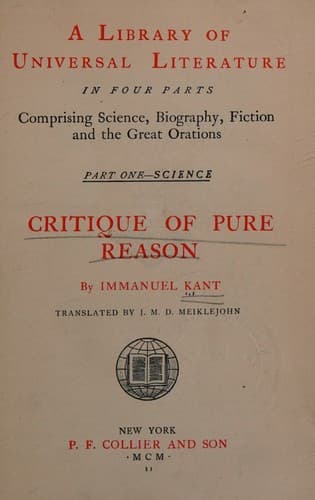
Causation; Knowledge, Theory of; Philosophy, German; Reason
Now the question arises how a thing passes from one state = a, into
another state = b. Between two moments there is always a certain time,
and between two states existing in these moments there is always a
difference having a certain quantity (for all parts of phenomena are
in their turn quantities). Consequently, every transition from one
state into another, is always effected in a time contained between
two moments, of which the first determines the state which the thing
leaves, and the second determines the state into which the thing
passes. Both moments, then, are limitations of the time of a change,
consequently of the intermediate state between both, and as such they
belong to the total of the change. Now every change has a cause, which
evidences its causality in the whole time during which the charge takes
place. The cause, therefore, does not produce the change all at once or
in one moment, but in a time, so that, as the time gradually increases
from the commencing instant, a, to its completion at b, in like manner
also, the quantity of the reality (b - a) is generated through the
lesser degrees which are contained between the first and last. All
change is therefore possible only through a continuous action of the
causality, which, in so far as it is uniform, we call a momentum. The
change does not consist of these momenta, but is generated or produced
by them as their effect.
Such is the law of the continuity of all change, the ground of which is
that neither time itself nor any phenomenon in time consists of parts
which are the smallest possible, but that, notwithstanding, the state
of a thing passes in the process of a change through all these parts,
as elements, to its second state. There is no smallest degree of
reality in a phenomenon, just as there is no smallest degree in the
quantity of time; and so the new state of reality grows up out of the
former state, through all the infinite degrees thereof, the differences
of which one from another, taken all together, are less than the
difference between 0 and a.
It is not our business to inquire here into the utility of this
principle in the investigation of nature. But how such a proposition,
which appears so greatly to extend our knowledge of nature, is possible
completely à priori, is indeed a question which deserves investigation,
although the first view seems to demonstrate the truth and reality of
the principle, and the question, how it is possible, may be considered
superfluous. For there are so many groundless pretensions to the
enlargement of our knowledge by pure reason that we must take it as a
general rule to be mistrustful of all such, and without a thoroughgoing
and radical deduction, to believe nothing of the sort even on the
clearest dogmatical evidence.
Public-domain text, read in full here on John Shaqi.
Reviews
Reviews
No reviews yet
Be the first to share your thoughts on this work.
Elsewhere in the archive
Join the Discussion
Join the discussion
Sign in to leave a comment or review.
Sign InorCreate an account