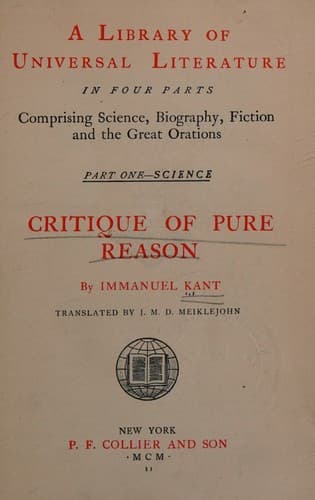
Causation; Knowledge, Theory of; Philosophy, German; Reason
we cannot cogitate such a possibility in concreto without the aid of
experience; because reality is concerned only with sensation, as the
matter of experience, and not with the form of thought, with which we
can no doubt indulge in shaping fancies.
But I pass by everything which derives its possibility from reality in
experience, and I purpose treating here merely of the possibility of
things by means of à priori conceptions. I maintain, then, that the
possibility of things is not derived from such conceptions per se, but
only when considered as formal and objective conditions of an
experience in general.
It seems, indeed, as if the possibility of a triangle could be cognized
from the conception of it alone (which is certainly independent of
experience); for we can certainly give to the conception a
corresponding object completely à priori, that is to say, we can
construct it. But as a triangle is only the form of an object, it must
remain a mere product of the imagination, and the possibility of the
existence of an object corresponding to it must remain doubtful, unless
we can discover some other ground, unless we know that the figure can
be cogitated under the conditions upon which all objects of experience
rest. Now, the facts that space is a formal condition à priori of
external experience, that the formative synthesis, by which we
construct a triangle in imagination, is the very same as that we employ
in the apprehension of a phenomenon for the purpose of making an
empirical conception of it, are what alone connect the notion of the
possibility of such a thing, with the conception of it. In the same
manner, the possibility of continuous quantities, indeed of quantities
in general, for the conceptions of them are without exception
synthetical, is never evident from the conceptions in themselves, but
only when they are considered as the formal conditions of the
determination of objects in experience. And where, indeed, should we
look for objects to correspond to our conceptions, if not in
experience, by which alone objects are presented to us? It is, however,
true that without antecedent experience we can cognize and characterize
the possibility of things, relatively to the formal conditions, under
which something is determined in experience as an object, consequently,
completely à priori. But still this is possible only in relation to
experience and within its limits.
The postulate concerning the cognition of the reality of things
requires perception, consequently conscious sensation, not indeed
immediately, that is, of the object itself, whose existence is to be
cognized, but still that the object have some connection with a real
perception, in accordance with the analogies of experience, which
exhibit all kinds of real connection in experience.
Public-domain text, read in full here on John Shaqi.
Reviews
Reviews
No reviews yet
Be the first to share your thoughts on this work.
Elsewhere in the archive
Join the Discussion
Join the discussion
Sign in to leave a comment or review.
Sign InorCreate an account