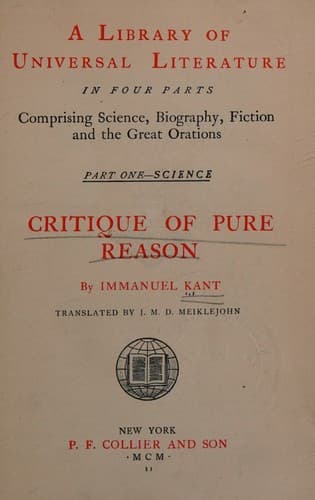
Causation; Knowledge, Theory of; Philosophy, German; Reason
It may be said that the object of a merely transcendental idea is
something of which we have no conception, although the idea may be a
necessary product of reason according to its original laws. For, in
fact, a conception of an object that is adequate to the idea given by
reason, is impossible. For such an object must be capable of being
presented and intuited in a Possible experience. But we should express
our meaning better, and with less risk of being misunderstood, if we
said that we can have no knowledge of an object, which perfectly
corresponds to an idea, although we may possess a problematical
conception thereof.
Now the transcendental (subjective) reality at least of the pure
conceptions of reason rests upon the fact that we are led to such ideas
by a necessary procedure of reason. There must therefore be syllogisms
which contain no empirical premisses, and by means of which we conclude
from something that we do know, to something of which we do not even
possess a conception, to which we, nevertheless, by an unavoidable
illusion, ascribe objective reality. Such arguments are, as regards
their result, rather to be termed sophisms than syllogisms, although
indeed, as regards their origin, they are very well entitled to the
latter name, inasmuch as they are not fictions or accidental products
of reason, but are necessitated by its very nature. They are sophisms,
not of men, but of pure reason herself, from which the Wisest cannot
free himself. After long labour he may be able to guard against the
error, but he can never be thoroughly rid of the illusion which
continually mocks and misleads him.
Public-domain text, read in full here on John Shaqi.
Reviews
Reviews
No reviews yet
Be the first to share your thoughts on this work.
Elsewhere in the archive
Join the Discussion
Join the discussion
Sign in to leave a comment or review.
Sign InorCreate an account