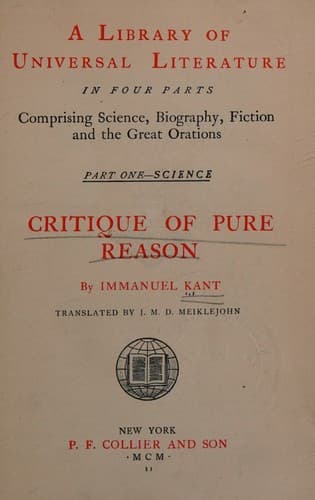
Causation; Knowledge, Theory of; Philosophy, German; Reason
substances, which appear under the form of matter, might (not indeed
by a mechanical or chemical influence upon each other, but by an
unknown influence, of which the former would be but the phenomenal
appearance), by means of such a dynamical division of the
parent-souls, as intensive quantities, produce other souls, while the
former repaired the loss thus sustained with new matter of the same
sort. I am far from allowing any value to such chimeras; and the
principles of our analytic have clearly proved that no other than an
empirical use of the categories—that of substance, for example—is
possible. But if the rationalist is bold enough to construct, on the
mere authority of the faculty of thought—without any intuition,
whereby an object is given—a self-subsistent being, merely because the
unity of apperception in thought cannot allow him to believe it a
composite being, instead of declaring, as he ought to do, that he is
unable to explain the possibility of a thinking nature; what ought to
hinder the materialist, with as complete an independence of
experience, to employ the principle of the rationalist in a directly
opposite manner—still preserving the formal unity required by his
opponent?
If, now, we take the above propositions—as they must be accepted as
valid for all thinking beings in the system of rational psychology—in
synthetical connection, and proceed, from the category of relation,
with the proposition: “All thinking beings are, as such, substances,”
backwards through the series, till the circle is completed; we come at
last to their existence, of which, in this system of rational
psychology, substances are held to be conscious, independently of
external things; nay, it is asserted that, in relation to the
permanence which is a necessary characteristic of substance, they can
of themselves determine external things. It follows that idealism—at
least problematical idealism, is perfectly unavoidable in this
rationalistic system. And, if the existence of outward things is not
held to be requisite to the determination of the existence of a
substance in time, the existence of these outward things at all, is a
gratuitous assumption which remains without the possibility of a proof.
But if we proceed analytically—the “I think” as a proposition
containing in itself an existence as given, consequently modality being
the principle—and dissect this proposition, in order to ascertain its
content, and discover whether and how this Ego determines its existence
in time and space without the aid of anything external; the
propositions of rationalistic psychology would not begin with the
conception of a thinking being, but with a reality, and the properties
of a thinking being in general would be deduced from the mode in which
this reality is cogitated, after everything empirical had been
abstracted; as is shown in the following table:
1
I think,
Public-domain text, read in full here on John Shaqi.
Reviews
Reviews
No reviews yet
Be the first to share your thoughts on this work.
Elsewhere in the archive
Join the Discussion
Join the discussion
Sign in to leave a comment or review.
Sign InorCreate an account