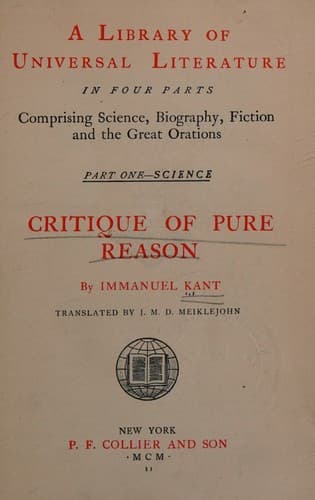
Causation; Knowledge, Theory of; Philosophy, German; Reason
We apply the term sensibility to the receptivity of the mind for
impressions, in so far as it is in some way affected; and, on the other
hand, we call the faculty of spontaneously producing representations,
or the spontaneity of cognition, understanding. Our nature is so
constituted that intuition with us never can be other than sensuous,
that is, it contains only the mode in which we are affected by objects.
On the other hand, the faculty of thinking the object of sensuous
intuition is the understanding. Neither of these faculties has a
preference over the other. Without the sensuous faculty no object would
be given to us, and without the understanding no object would be
thought. Thoughts without content are void; intuitions without
conceptions, blind. Hence it is as necessary for the mind to make its
conceptions sensuous (that is, to join to them the object in
intuition), as to make its intuitions intelligible (that is, to bring
them under conceptions). Neither of these faculties can exchange its
proper function. Understanding cannot intuite, and the sensuous faculty
cannot think. In no other way than from the united operation of both,
can knowledge arise. But no one ought, on this account, to overlook the
difference of the elements contributed by each; we have rather great
reason carefully to separate and distinguish them. We therefore
distinguish the science of the laws of sensibility, that is, æsthetic,
from the science of the laws of the understanding, that is, logic.
Now, logic in its turn may be considered as twofold—namely, as logic of
the general, or of the particular use of the understanding. The first
contains the absolutely necessary laws of thought, without which no use
whatsoever of the understanding is possible, and gives laws therefore
to the understanding, without regard to the difference of objects on
which it may be employed. The logic of the particular use of the
understanding contains the laws of correct thinking upon a particular
class of objects. The former may be called elemental logic—the latter,
the organon of this or that particular science. The latter is for the
most part employed in the schools, as a propædeutic to the sciences,
although, indeed, according to the course of human reason, it is the
last thing we arrive at, when the science has been already matured, and
needs only the finishing touches towards its correction and completion;
for our knowledge of the objects of our attempted science must be
tolerably extensive and complete before we can indicate the laws by
which a science of these objects can be established.
Public-domain text, read in full here on John Shaqi.
Reviews
Reviews
No reviews yet
Be the first to share your thoughts on this work.
Elsewhere in the archive
Join the Discussion
Join the discussion
Sign in to leave a comment or review.
Sign InorCreate an account