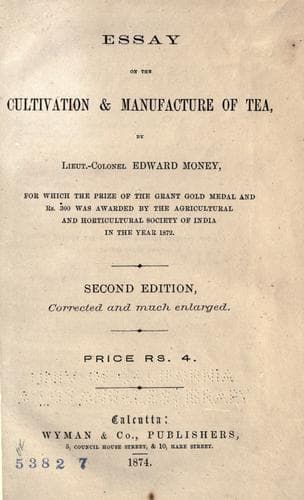
The Cultivation and Manufacture of TeaMoney, Edward
Science
The Cultivation and Manufacture of Tea
Money, Edward
Tea
“‘I believe that three maunds per acre is fully one-third more than
the present average yield of gardens in Cachar, after deducting the
area of plant under yielding age.
“‘There is no reason, that I am aware of, why the yield of Tea should
not soon be raised to four maunds, and more gradually six maunds per
acre, equal to twenty-four maunds of leaf per acre (less than one
ton per acre for a green crop, which is still a very small one).
Even now there are gardens in Cachar which give an average of from
five to six maunds per acre this season. Some of these gardens have
really no apparent advantage over their less fortunate neighbours,
beyond that of a somewhat better system of cultivation and pruning;
and these improvements even are to such a small degree ahead of the
general practice, that I feel justified in saying I cannot place a
limit on what the increased yield should be under a more rational
system of cultivation, and the application of manures on a liberal
scale, leaving out of consideration altogether what might reasonably
be expected from a good system of drainage in addition.’
“Mr. James Stuart, Manager of the Bengal Tea Company’s gardens in
Cachar, has also given two maunds an acre as the general average of
Cachar gardens for the past season, including young gardens of two,
three, and four years old.
“We do not think it necessary to quote in detail the opinions of all
the gentlemen examined by us on the subject of average produce per
acre. A garden that can give four maunds per acre is undoubtedly a
good one, and we have no doubt there are such, or even better; but we
do not think they are so common as to warrant our taking more than
three maunds as a safe average.”
Mr. A. C. Campbell, Extra Assistant Commissioner at Burpettah, in his
“Notes on Tea Cultivation in Assam,” published in the Journal of the
Agricultural and Horticultural Society of India, part 3, vol. xii.,
page 309, says:--“Good Tea land can be made to yield as high as seven
maunds per poora.” I forget exactly how much a poora is, but I believe
it is nearly an acre.
In the Report to Government by the Commissioners, quoted above, at page
9, Mr. T. Burland, after estimating the cost of cultivation per acre
per mensem at Rs. 9-10-2, adds:--“With the above expenditure per acre
it is probable that much more than five maunds of Tea will be obtained
from an acre of fair plant.”[78]
All these estimates, however, are based on the cultivation of Tea as
carried on hitherto with few exceptions, that is to say, on gardens
covered with weeds for many months in the year, and to which no manure
has ever been given. With such cultivation, particularly on gardens
planted on slopes, I think myself that the yield will not exceed four
maunds _at the outside_.
Public-domain text, read in full here on John Shaqi.
Reviews
Reviews
No reviews yet
Be the first to share your thoughts on this work.
Elsewhere in the archive
Join the Discussion
Join the discussion
Sign in to leave a comment or review.
Sign InorCreate an account