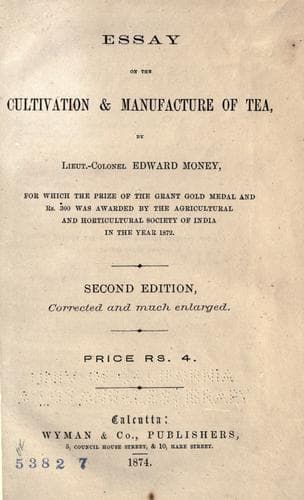
The Cultivation and Manufacture of TeaMoney, Edward
Science
The Cultivation and Manufacture of Tea
Money, Edward
Tea
I submit for your inspection a sample of coarse leaf sifted out of
a parcel of good quality, and the proportion of similar stuff in
the chop amounts to fully 3 per cent., very much affecting the good
appearance of the fired leaf. This defect no doubt arises from the
attempted production of too great an amount of cured leaf for each
hand employed per diem in the process, to be attributed no doubt
to the enhanced cost of labour in the interior. But the defect is
of vital importance for the future of Japan Teas in America. The
buyer for distribution amongst consumers in that country is greatly
influenced by the “appearance” of the leaf, despite its relative
intrinsic quality in infusion, in comparison with a Tea of worse
appearance, hence the high facing and colouring at present so much
in vogue. If the Japanese producers continue the present style of
manufacturing the leaf up country, so surely will Japan Teas decline
in favour in America, as the foreign shipper here cannot make up the
leaf prepared up country to the standard required by the American
buyers, and with the prospect of a possibility of Oolongs and even
blacks becoming ere long dangerous rivals with consumers in the
United States, it behoves the Japanese Tea growers to turn their
attention towards an improvement in production in their own country
before they attempt to rival foreign competitors at this side.--Yours
faithfully,
YAMATO.
Yokohama, _Aug. 19, 1881_.
[We have inspected the sample of coarse leaf referred to in the above
letter, and though we cannot pretend to any critical knowledge of
Tea, we can confirm the statements of our correspondent, and hold the
specimen at our office, where it can be seen by anyone desirous of
doing so.--_Editor, Japan Herald._]
I know not where this next extract came from, but it appears they
understand adulteration in Japan:--
Mr. Yanagiya might, however, have gone a step farther, and have given
particulars of the various analyses, and have mentioned that the
“leaf” of the various samples showed a large proportion of leaves
quite different to those of the Tea shrub, and for the presence
of which not even the astute foreigner--that bugbear of Japanese
commerce--can be held accountable.
We have heard this season loud complaints of the presence of leaves
entirely distinct from those of the Tea plant amongst purchases.
These consisted principally of wisteria, willow and a species of ash,
but the native growers were impartial, and several other species of
shrubs also contributed their quota to the frauds practised by the
Japanese.
Public-domain text, read in full here on John Shaqi.
Reviews
Reviews
No reviews yet
Be the first to share your thoughts on this work.
Elsewhere in the archive
Join the Discussion
Join the discussion
Sign in to leave a comment or review.
Sign InorCreate an account