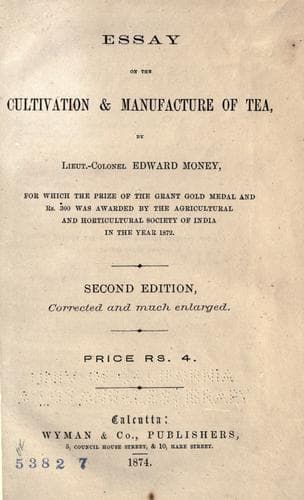
The Cultivation and Manufacture of TeaMoney, Edward
Science
The Cultivation and Manufacture of Tea
Money, Edward
Tea
The letter of our correspondent “A. E. T.” calls attention for the
hundredth time to the failure of the planting interest to make the
most of the local demand for Indian Teas. It is only necessary to
compare the prices realised at the public auctions with those at
which even the most liberal of our retail firms offer to supply
their customers with such Teas to see that but a very small fraction
of the difference between the prime cost of the Tea and what the
consumer has to pay for it goes into the pocket of the planter. It is
probably no exaggeration to say that while the consumer pays, on the
average, from twelve annas to a rupee per pound more than the actual
cost of the Tea laid down in Calcutta, the planter may think himself
fortunate if he can appropriate from half an anna to an anna of this
sum. By whatever course of argument the fact may be justified, it is
certainly not justifiable by the equity of the case as it appears
to ordinary minds. For it is the planter who has borne the heat and
burden of the day, and the proportion which the capital invested by
him bears to the ultimate return is immensely greater in his case
than in that of the retail dealer.
On whom does the blame for the continuance of this state of things,
if blame there be in the matter, rest? Hardly on the public. They
would only be too glad to allow the Tea planter, say, four times
his present profit instead of allowing twelve times that profit to
a middleman or a series of middlemen. The public, however, can give
their custom only to those who bid for it, and who consult their
convenience in the arrangements they make to secure it.
It is evidently the planter, and the planter alone, who can move in
the matter. But whether out of regard for the interests of the retail
dealer, or from a belief that the game is not worth the candle, he
does not move. If there were a retail Tea trade worthy of the name,
in the proper sense of the term, in Calcutta, it would probably not
be to the interest of planters to enter into competition with it.
But though we have many retail establishments who deal in Tea, its
sale is, in the great majority of cases, only one item of a very
multifarious business, the profit on which, as a whole, is probably
not excessive under all the circumstances of the case.
As to the game not being worth the candle, that is possibly the case
if only the present demand is considered. But we are persuaded that
it is otherwise if regard is had to the expansion of which that
demand is capable.
Public-domain text, read in full here on John Shaqi.
Reviews
Reviews
No reviews yet
Be the first to share your thoughts on this work.
Elsewhere in the archive
Join the Discussion
Join the discussion
Sign in to leave a comment or review.
Sign InorCreate an account