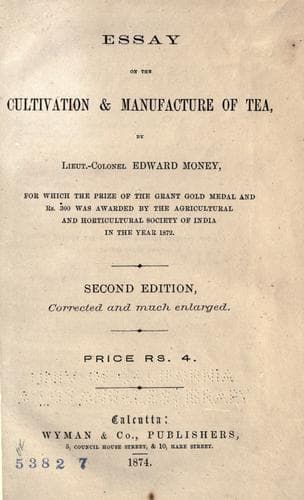
The Cultivation and Manufacture of TeaMoney, Edward
Science
The Cultivation and Manufacture of Tea
Money, Edward
Tea
This applies to packages of all sizes and kinds, if the tares are equal
or nearly so. If the difference in the tares are not great, an average
is struck. If tares are various all are turned out!
CHAPTER XXXVII.
WEIGHING AND BULKING OF INDIAN TEAS AT CUSTOM HOUSE.
One misapprehension with some exists on this head. The _weighing_ is
done by the Customs to ascertain the amount for duty. The _bulking_ is
done at the request of the vendor, the broker who is to sell it, or the
purchaser, and it has to be paid for.
Two distinct injuries are inflicted on the producer by the present
Custom House system--
1. The Tea is much damaged by exposure.
2. The quantity found is _always_ less than the actual.
Now as to No. 1. When we consider how damp the London atmosphere is
at the best, how in foggy days it teems with moisture, is it not very
certain that Teas exposed to it, often for days, deteriorate? What
care we take in India heating before packing--carefully with lead
and solder, excluding all air--and then the Teas on arrival here are
treated as above! It is simply monstrous.
The following extract from a letter to _Home and Colonial Mail_ sets
out the case forcibly:--
The blame ought not entirely to be laid upon the planter, however,
for certain facts have come to our knowledge during the present week
as regards the manner in which Indian Teas are bulked at some of
the London warehouses, which somewhat explains how depreciation in
quality comes about. We bought several breaks of Tea in the sales
this week, which were stated to be bulked and ready for sampling six
days before the sale; and yet we know for a fact that some of those
very Teas were not put back into the chest till the day after the
sale, if even then. More or less moisture is always to be found in
the London atmosphere, particularly in rainy weather, and there can
be no question that incalculable injury would be done to a fine Tea
by seven days’ exposure on the floor of a warehouse. The damage and
loss falls entirely on the buyer. The effects of it are not seen at
once, but there can be little doubt that a gradual depreciation sets
in, consequent on the absorption of moisture. No redrying process
follows; the Tea is simply filled back into the chests when seven
days of neglect have done what mischief is possible. Is it to be
wondered at that samples drawn from such a break of Tea a few months
after it has been bulked in London will have lost all their freshness
and malty smell?
J. C. TAYLOR AND COLMAN.
I have no reason to think the delay above is very unusual, and I must
add to the above, that when the chests are closed no attempt is made
even to cover the top with lead, much less to resolder it. Some paper
on top is all attempted. I need say no more to prove that the quality
of Indian Teas is _most_ seriously damaged at the Custom House.
Now as to No. 2. The loss in quantity to producer.
Public-domain text, read in full here on John Shaqi.
Reviews
Reviews
No reviews yet
Be the first to share your thoughts on this work.
Elsewhere in the archive
Join the Discussion
Join the discussion
Sign in to leave a comment or review.
Sign InorCreate an account