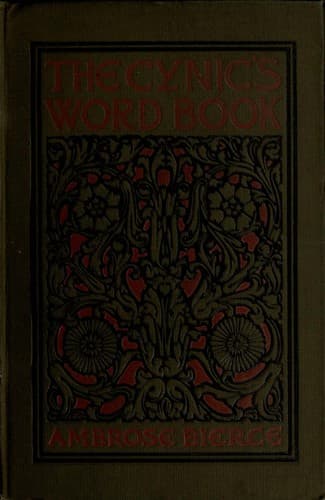
English language -- Dictionaries -- Humor; English language -- Semantics -- Humor; Vocabulary -- Humor
INK, n. A villainous compound of tannogalate of iron, gum-arabic, and
water, chiefly used to facilitate the infection of idiocy and
promote intellectual crime. The properties of ink are peculiar and
contradictory: it may be used to make reputations and unmake them;
to blacken them and to make them white; but it is most generally and
acceptably employed as a mortar to bind together the stones in an
edifice of fame, and as a whitewash to conceal afterward the rascal
quality of the material. There are men called journalists who have
established ink baths which some persons pay money to get into, others
to get out of. Not infrequently it occurs that a person who has paid to
get in pays twice as much to get out.
INNATE, adj. Natural; inherent--as, innate ideas, that is to say, ideas
that we are born with, having had them previously imparted to us.
The doctrine of innate ideas is one of the most admirable faiths of
philosophy, being itself an innate idea and therefore inaccessible to
disproof, though Locke foolishly supposed himself to have given it "a
black eye." Among innate ideas may be mentioned the belief in one's
ability to conduct a newspaper, in the greatness of one's country, in
the superiority of one's civilization, in the importance of one's
personal affairs and in the interesting nature of one's diseases.
IN'ARDS, n. The stomach, heart, soul, and other bowels. Many eminent
investigators do not class the soul as an in'ard, but that acute
observer and renowned authority, Dr. Gunsaulus, is persuaded that the
mysterious organ known as the spleen is nothing less than our immortal
part. To the contrary, Professor Garrett P. Serviss holds that man's
soul is that prolongation of his spinal marrow which forms the pith of
his no tail; and for demonstration of his faith points confidently
to the fact that tailed animals have no souls. Concerning these two
theories, it is best to suspend judgment by believing both.
INSCRIPTION, n. Something written on another thing. Inscriptions are
of many kinds, but mostly memorial, intended to commemorate the fame of
some illustrious person and hand down to distant ages the record of his
services and virtues. To this class of inscriptions belongs the name of
John Smith, pencilled on the Washington monument. Following are examples
of memorial inscriptions on tombstones:
"In the sky my soul is found,
And my body in the ground.
By and by my body 'll rise
To join my spirit in the skies,
Soaring up to Heaven's gate.
1878."
"Sacred to the memory of Jeremiah Tree.
Cut down May 9th, 1862, aged 27 yrs. 4 mos.
and 12 ds. Indigenous."
"Affliction sore long time she boar,
Phisicians was in vain,
Till Deth released the dear deceased
And left her a remain.
Gone to join Ananias and Saphiar in the regions of
bliss."
Public-domain text, read in full here on John Shaqi.
Reviews
Reviews
No reviews yet
Be the first to share your thoughts on this work.
Join the Discussion
Join the discussion
Sign in to leave a comment or review.
Sign InorCreate an account