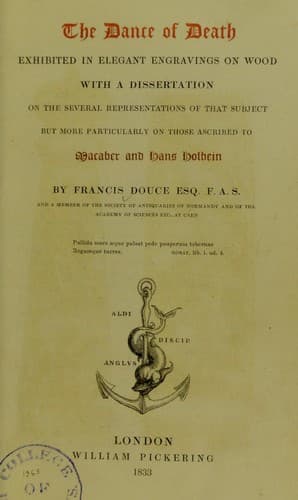
The Dance of Death: Exhibited in Elegant Engravings on Wood with a Dissertation on the Several Representations of that Subject but More Particularly on Those Ascribed to Macaber and Hans HolbeinDouce, Francis
History
The Dance of Death: Exhibited in Elegant Engravings on Wood with a Dissertation on the Several Representations of that Subject but More Particularly on Those Ascribed to Macaber and Hans Holbein
Douce, Francis
Bible. Old Testament -- Illustrations; Dance of death
The subjects are the following:--1. The Creation. 2. The Fall. 3.
Expulsion from Paradise. 4. Punishment of Man. 5. Triumph of Death. 6. An
allegorical frontispiece relating to the class of the Clergy. 6. The Pope.
7. The Cardinal. 8. The Bishop. 9. The Abbot. 10. The Abbess. 11. The
Priest. 12. The Monk. 13. The Hermit. 14. The Preacher. 15. An allegorical
frontispiece to the class of Rulers and Governors. 15. The Emperor. 16.
The Empress. 17. The King. 18. The Queen. 19. The Prince Elector. 20. The
Earl and Countess. 21. The Knight. 22. The Nobleman. 23. The Judge. 24.
The Steward, Widow, and Orphan. 25. The Captain. 26. An allegorical
frontispiece to the Lower Classes. 26. The Physician. 27. The Astrologer.
28. The Merchant. 29. The Painter and his kindred: among these the old man
is Dietrich Meyern; the painter resembles the portrait of Conrad Meyern in
Sandrart, and the man at the table is probably Rudolph Meyern. 30. The
Handcraftsman. 31. The Architect. 32. The Innkeeper. 33. The Cook. 34. The
Ploughman. 35. The Man and Maid Servant. 36. The old Man. 37. The old
Woman. 38. The Lovers. 39. The Child. 40. The Soldier. 41. The Pedler. 42.
The Highwayman. 43. The Quack Doctor. 44. The Blind Man. 45. The Beggar.
46. The Jew. 47. The Usurer. 48. The Gamesters. 49. The Drunkards. 50. The
Gluttons. 51. The Fool. 52. The Certainty of Death. 53. The Uncertainty
of Death. 54. The Last Judgment. 55. Christ's Victory. 56. Salvation. 57.
True and False Religion.
The text consists chiefly of Death's apostrophe to his victims, with their
remonstrances, verses under each subject, and various other matters. At
the end are pious songs and psalms set to music. This work was jointly
executed by two excellent artists, Rodolph and Conrad Meyer or Meyern,
natives of Zurich. The designs are chiefly by Rodolph, and the etchings by
Conrad, consisting of sixty very masterly compositions. The grouping of
the figures is admirable, and the versatile representations of Death most
skilfully characterized. Many of the subjects are greatly indebted to the
Lyons wood engravings.
Public-domain text, read in full here on John Shaqi.
Reviews
Reviews
No reviews yet
Be the first to share your thoughts on this work.
Elsewhere in the archive
Join the Discussion
Join the discussion
Sign in to leave a comment or review.
Sign InorCreate an account