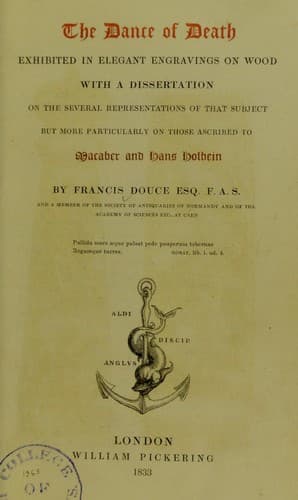
The Dance of Death: Exhibited in Elegant Engravings on Wood with a Dissertation on the Several Representations of that Subject but More Particularly on Those Ascribed to Macaber and Hans HolbeinDouce, Francis
History
The Dance of Death: Exhibited in Elegant Engravings on Wood with a Dissertation on the Several Representations of that Subject but More Particularly on Those Ascribed to Macaber and Hans Holbein
Douce, Francis
Bible. Old Testament -- Illustrations; Dance of death
V. "Den Algemeynen dooden Spiegel van Pater Abraham à Sancta Clara,"
_i. e._ The universal mirror of Death of Father Abraham à Sancta Clara. On
a frontispiece engraved on copper, with a medallion of the author, and
various allegorical figures. Then the printed title, "Den Algemeynen
Dooden spiegel ofte de capelle der Dooden waer in alle Menschen sich al
lacchende oft al weenende op recht konnen beschouwen verciert mer aerdige
historien, Siu-rycke gedichten ende sedenleer-ende Beeldt-schetsen op
gestelt door den eerweerdigen Pater Abraham à Sancta Clara Difinitor der
Provincie van het order der ongeschoende Augustynen ende Predickant van
syne Keyserlycke Majesteyt Leopoldus. Getrouwelyck overgeset vyt het
hoogh-duyts in onse Nederduytsche Taele. Tot Brussel, by de Wed. G. Jacobs
tegen de Baert-brugge in de Druckerye, 1730." 12mo. _i. e._ "The universal
mirror of Death taken from the chapel of the dead; in which all men may
see themselves properly, whether laughing or weeping, ornamented with
pretty stories, spirited poems, and instructive prints, arranged by Father
Abraham à Sancta Clara, of the Augustinian order, and preacher to his
Imperial Majesty Leopold, and faithfully translated out of High Dutch into
our Netherlandish language."
The work consists of sixty-seven engravings on wood within borders, and of
very indifferent execution in all respects; the text a mixture of prose
and poetry of a religious nature, allusive to the subjects, which are not
uniformly a dance of Death. The best among them are the Painter, p. 45;
the Drunkard, p. 75; the dancing Couple, Death playing the Flageolet, p.
103; the Fowler, p. 113; the hen-pecked Husband, p. 139; the Courtezan, p.
147; the Musician, p. 193; the Gamester, p. 221; and the blind Beggar, p.
289.
VI. "Geistliche Todts-Gedanchen bey allerhand semahlden und Tchildereyn in
vabildung Interschiedlichen geschlechts, alters, standes, und wurdend
perschnen sich des Todes zucrinneren ans dessen lehrdie tugende zuüben und
die Tundzu meyden Erstlich in kupfer entworffen nachmaler durch sittliche
erdrtherung und aberlegung unter Todten-farben in vorschem gebracht,
dardurch zumheyl der seelen im gemuth des geneighten lesers ein lebendige
forcht und embsige vorsorg des Todes zu erwecken. Cum permissu superiorum.
Passau Gedrucht bey Frederich Gabriel Mangold, hochfurst, hof
buchdruckern, 1753. Lintz, verlegts Frantz Anton Ilger, Burgerl,
Buchhandlern allda." Folio. In English, "The Spiritual Dance of Death in
all kinds of pictures and representations, whereby persons of every age,
sex, rank, and dignity, may be reminded of Death, from which lesson they
may exercise themselves in virtue, and avoid sin. First put upon copper,
and afterwards, through moral considerations and investigations brought to
light in Death's own colours, thereby for the good of the souls of the
well inclined readers to awaken in them a lively fear and diligent
anticipation of Death."
Public-domain text, read in full here on John Shaqi.
Reviews
Reviews
No reviews yet
Be the first to share your thoughts on this work.
Elsewhere in the archive
Join the Discussion
Join the discussion
Sign in to leave a comment or review.
Sign InorCreate an account