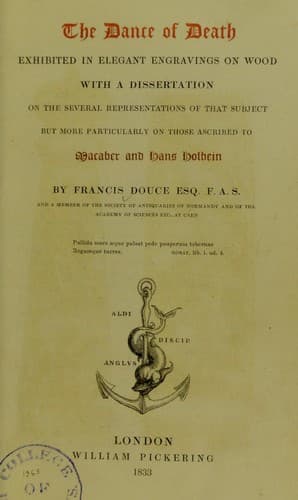
The Dance of Death: Exhibited in Elegant Engravings on Wood with a Dissertation on the Several Representations of that Subject but More Particularly on Those Ascribed to Macaber and Hans HolbeinDouce, Francis
History
The Dance of Death: Exhibited in Elegant Engravings on Wood with a Dissertation on the Several Representations of that Subject but More Particularly on Those Ascribed to Macaber and Hans Holbein
Douce, Francis
Bible. Old Testament -- Illustrations; Dance of death
A German translation of the well known block book, the "Ars Moriendi," was
printed at Dilingen, 1569, 12mo. with several additional engravings on
wood. It is perhaps the last publication of the work. On the title-page is
an oval cut, representing a winged boy sleeping on a scull, and Death
shooting an arrow at him. The first cut exhibits a sort of Death's dance,
in eight small compartments. 1. A woman in bed just delivered of a child,
with which Death is running away. 2. A man sitting at a table, Death
seizes him behind, and pulls him over the bench on which he is sitting. 3.
Death drowning a man in a river. 4. Flames of fire issue from a house,
Death tramples on a man endeavouring to escape. 5. Two men fighting, one
of whom pierces the other with his sword. The wounded man is seized by
Death, the other by the Devil. 6. A man on horseback is seized by Death
also mounted behind. 7. Death holds his hour-glass to a man on his
death-bed. 8. Death leading an aged man to the grave. At the end of this
curious volume is a singular cut, intitled "Symbolum M. Joannis Stotzinger
Presbyteri Dilingensis." It exhibits a young man sitting at a table, on
which is a violin, music books, and an hour-glass. On the table is written
RESPICE FINEM. Near him his guardian angel holding a label, inscribed
ANGELVS ASTAT. Behind them Death about to strike the young man with his
dart, and over him MORS MINATVR. At the end of the table Conscience as a
female, whom a serpent bites, with the label CONSCIENTIA MORDET, and near
her the Devil, with the label DIABOLVS ACCVSAT. Above is the Deity looking
down, and the motto DEVS VIDET.
"Il Cavallero Determinado," Antwerp, 1591, 4to. A translation from the
French romance of Olivier de la Marche, with etchings by Vander Borcht.
The last print represents Death, armed with a coffin lid as a shield,
attacking a knight on horseback. In several of the other prints Death is
represented under the name of Atropos, as president in tournaments. In
other editions the cuts are on wood by the artist with the mark [monogram:
A].
In the margins of some of the Horæ, printed by Thielman Kerver, there are
several grotesque figures of Death, independently of the usual Dance.
In many of the Bibles that have prints to the Revelations, that of Death
on the pale horse is to be noticed.
In Petrarch's work "de remediis utriusque fortunæ," both in the German and
Latin editions, there are several cuts that relate materially to the
subject. It may be as well to mention that this work has been improperly
ascribed to Petrarch.
In many of the old editions of Petrarch's works which contain the
triumphs, that of Death is usually accompanied with some terrific print of
Death in a car drawn by oxen, trampling upon all conditions of men from
the pope to the beggar.
Public-domain text, read in full here on John Shaqi.
Reviews
Reviews
No reviews yet
Be the first to share your thoughts on this work.
Elsewhere in the archive
Join the Discussion
Join the discussion
Sign in to leave a comment or review.
Sign InorCreate an account