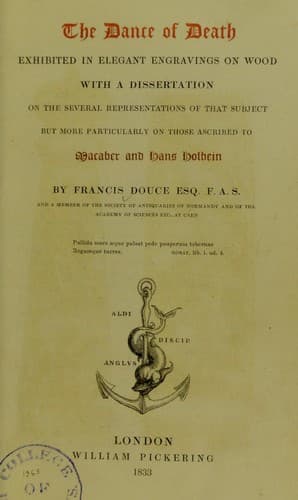
The Dance of Death: Exhibited in Elegant Engravings on Wood with a Dissertation on the Several Representations of that Subject but More Particularly on Those Ascribed to Macaber and Hans HolbeinDouce, Francis
History
The Dance of Death: Exhibited in Elegant Engravings on Wood with a Dissertation on the Several Representations of that Subject but More Particularly on Those Ascribed to Macaber and Hans Holbein
Douce, Francis
Bible. Old Testament -- Illustrations; Dance of death
Bishop Warburton and Mr. Malone have referred to old Moralities, in which
the fool escaping from the pursuit of Death is introduced. Ritson has
denied the existence of any such farces, and he is perhaps right with
respect to printed ones; but vestiges of such a drama were observed
several years ago at the fair of Bristol by the present writer. See the
notes to Measure for Measure, Act iii. sc. 1, and to Pericles, Act iii.
sc. 2.
In "Musart Adolescens Academicus sub institutione Salomonis," Duaci, 1633,
12mo. is an engraving on copper of a modern Bacchus astride upon a wine
cask drawn by two tigers. In one hand he holds a thyrsus composed of
grapes and vine leaves, and in the other a cup or vase, from which a
serpent springs, to indicate poison. Behind this Bacchus Death is seated,
armed with his scythe and lying in wait for him. The motto, "Vesani
calices quid non fecere," a parody on the line, "Fecundi calices quem non
fecere disertum?" Horat. lib. i. epist. v. 1. 19.
In "Christopher Van Sichem's Bibels' Tresoor," 1646, 4to. there is a
wood-cut of Death assisting Adam to dig the ground, partly copied from the
subject of "the Curse," in the work printed at Lyons.
In "De Chertablon, maniere de se bien preparer à la mort, &c." Anvers,
1700, 4to. there is an allegorical print in which a man is led by his
guardian angel to the dwelling of Faith, Hope, and Charity, but is
violently seized by Death, who points to his last habitation, in the shape
of a sepulchral monument.
In Luyken's "Onwaardige wereld," Amst. 1710, 12mo. are three allegorical
engravings relating to this subject.
In a very singular book, intitled "Confusio disposita rosis
rhetorico-poeticis fragrans, sive quatuor lusus satyrico morales, &c.
authore Josepho Melchiore Francisco a Glarus, dicto Tschudi de Greplang."
Augsburg, 1725, 12mo. are the following subjects. 1. The world as Spring,
represented by a fine lady in a flower-garden, Death and the Devil behind
her. 2. Death and the Devil lying in wait for the miser. 3. Death and the
Devil hewing down the barren fig-tree. 4. A group of dancers at a ball
interrupted by Death. 5. Death striking a lady in bed attended by her
waiting maid. 6. Death gives the coup-de-grace to a drunken fellow who had
fallen down stairs. 7. Death mounted on a skeleton-horse dashes among a
group of rich men counting their gold, &c. 8. A rich man refused entrance
into heaven. He has been brought to the gate in a sedan chair, carried by
a couple of Deaths in full-bottom periwigs.
In Luyken's "Vonken der lief de Jezus," Amst. 1727, 12mo. are several
engravings relating to the subject. In one of them Death pours a draught
into the mouth of a sick man in bed.
In Moncrief's "March of Intellect," 1830, 18mo. scene a workhouse, Death
brings in a bowl of soup, a label on the ground, inscribed "Death in the
pot." An engraving in wood after Cruikshank.
Public-domain text, read in full here on John Shaqi.
Reviews
Reviews
No reviews yet
Be the first to share your thoughts on this work.
Elsewhere in the archive
Join the Discussion
Join the discussion
Sign in to leave a comment or review.
Sign InorCreate an account