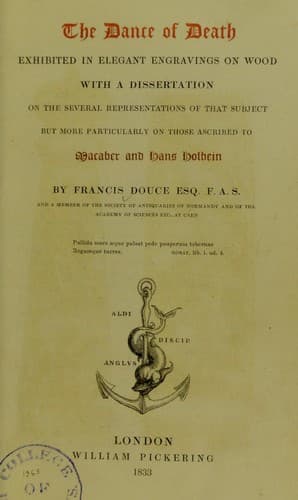
The Dance of Death: Exhibited in Elegant Engravings on Wood with a Dissertation on the Several Representations of that Subject but More Particularly on Those Ascribed to Macaber and Hans HolbeinDouce, Francis
History
The Dance of Death: Exhibited in Elegant Engravings on Wood with a Dissertation on the Several Representations of that Subject but More Particularly on Those Ascribed to Macaber and Hans Holbein
Douce, Francis
Bible. Old Testament -- Illustrations; Dance of death
"Das erneurte Stamm-und Stechbuchlein." By Fabian Athyr. Nuremberg, 1654.
Small obl. 4to.
"Mannichii Emblemata." Nuremberg, 1624, 4to.
"Minne Beelden toe-ghepast de Lievende Jonckheyt," Amst. 1635, 12mo. The
cuts on the subject are extremely grotesque and singular.
"Sciographia Cosmica." A description of the principal towns and cities in
the world, with views engraved by Paul Furst, and appropriate emblems. By
Daniel Meisner: in eight parts. Nuremberg, 1637. Oblong 4to. In the print
of the town of Freyburg, Death stands near an old man, and holds a clock
in one hand. In that of the city of Toledo Death accompanies a female who
has a mirror in her hand.
In the same work, at vol. A. 4, is a figure of Death trampling on Envy,
with the motto, "Der Todt mach dem Neyd ein ende." At A. 39, Death
intercepting a traveller, the motto, "Vitam morti obviam procedit." At A.
74, Death standing near a city, the motto, "Tros Tyriusve mihi nullo
discrimine habetur." At C. 9, a man and woman in the chains of matrimony,
which Death dissolves by striking the chain with a bone, the motto,
"Conjugii vinculum firmissimum est." At C. 30, Death about to mow down a
philosopher holding a clock, the motto, "Omnis dies, omnis hora, quam
nihil sumus ostendit." At E. 32, Death standing in the middle of a
parterre of flowers, holding in one hand a branch of laurel, in the other
a palm branch, the motto, "Ante mortem nullus beatus est." At E. 35, Death
shooting with a cross-bow at a miser before his chest of money, the motto,
"Nec divitiis nec auro." At E. 44, Death seizes a young man writing the
words, "sic visum superis" on a tablet, the motto, "Viva virtus est
funeris expers." At G. 32, Death pursues a king and a peasant, all on
horseback, the motto, "Mors sceptra ligonibus æquat." At G. 66, a woman
looking in a mirror sees Death, who stands behind her reflected, the
motto, "Tota vita sapientis est meditatio mortis." At H. 66, a company of
drunkards. Death strikes one of them behind when drinking, the motto,
"Malus inter poculo mos est." At H. 80, Death cuts down a genealogical
tree, with a young man and woman, the motto, "Juventus proponit, mors
disponit."
"Conrad Buno Driestandige Sinnbilder," 1643. Oblong 4to.
"Amoris divini et humani antipathia." Antw. 1670. 12mo.
"Typotii Symbola varia diversorum principum sacrosanctæ ecclesiæ et sacri
Imperii Romani." Arnheim, 1679. 12mo.
In Sluiter's "Somer en winter leven," Amst. 1687, 12mo. is a figure of
Death knocking at the door of a house and alarming the inhabitants with
his unexpected visit. The designer most probably had in his recollection
Horace's "Mors æquo pede pulsat pauperum tabernas regumque turres."
"Euterpe soboles hoc est emblemata varia, &c." with stanzas in Latin and
German to each print. No date. Oblong 4to. The engravings by Peter Rollo.
Republished at Paris, with this title, "Le Centre de l'amour, &c." A Paris
chez Cupidon. Same form, and without date. This edition has several
additional cuts.
Public-domain text, read in full here on John Shaqi.
Reviews
Reviews
No reviews yet
Be the first to share your thoughts on this work.
Elsewhere in the archive
Join the Discussion
Join the discussion
Sign in to leave a comment or review.
Sign InorCreate an account