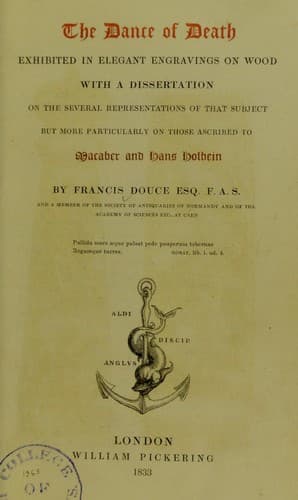
The Dance of Death: Exhibited in Elegant Engravings on Wood with a Dissertation on the Several Representations of that Subject but More Particularly on Those Ascribed to Macaber and Hans HolbeinDouce, Francis
History
The Dance of Death: Exhibited in Elegant Engravings on Wood with a Dissertation on the Several Representations of that Subject but More Particularly on Those Ascribed to Macaber and Hans Holbein
Douce, Francis
Bible. Old Testament -- Illustrations; Dance of death
There appears to have been another edition of this book, the title-page
only of which is preserved among Bagford's collections among the Harl.
MSS. No. 5930. It has the same printed title, with the initials W. C. and
the name of W. Stansby. It is also without date. This frontispiece is on a
curtain held by two winged boys. At the top, a figure of Death, at bottom
another of Time kneeling on a globe. In the right-hand corner, which is
torn, there seems to have been a hand coupé with a bracelet as a crest; in
the left, a coat of arms with a cross boutonné arg. and sable, and four
mullets, arg. and sable. On each side, four oval compartments, with the
following subjects. 1. A pope, a cardinal, and four bishops. 2. Several
monks and friars. 3. Several magistrates. 4. A schoolmaster reading to his
pupils. 5. An emperor, a king, a queen, a duke, a duchess, and a male
attendant. 6. A group of noblemen or gentlemen. 7. A painter painting a
figure of Death, in the back ground a woman who seems to be purchasing
articles of dress. 8. Two men with spades, one of them digging. This very
beautiful print is engraved by T. Cecil. On the top of each of the above
compartments, Death holds a string with both his hands.
"Theatrum omnium miserarum." A theatre filled with a vast number of
people. In the centre, an obelisk on a pedestal, behind which is a small
stage with persons sitting. In the foreground, Death holding a cord, with
which three naked figures are bound, and another Death with a naked figure
in a net. Between these figures symbols of the world, the flesh, and the
Devil. 4to.
"Les Consolations de l'Ame fidelle contre les frayeurs de la mort." Death
holds his scythe over a group of persons, consisting of an old man and a
child near a grave, who are followed by a king, queen, and a shepherd,
with various pious inscriptions. 8vo.
"La maniere de se bien preparer à la mort, par M. de Chertablon." Anvers,
1700, 4to.
In an engraved frontispiece, a figure of Time or Death trampling upon a
heap of articles expressive of worldly pomp and grandeur, strikes one end
of his scythe against the door of a building, on which is inscribed
"STATVTVM EST OMNIBVS HOMINIBVS. SEMEL MORI. Hebr. ix."
At the bottom, within a frame ornamented with emblems of mortality, a
sarcophagus with the skeleton of a man raised from it. Two Deaths are
standing near, one of whom blows a trumpet, the other points upward with
one hand, and holds a scythe in the other. On one side of the sarcophagus
are several females weeping; on the other, a philosopher sitting, who
addresses a group of sovereigns, &c. who are looking at the skeleton.
"Palingenii Zodiacus Vitæ." Rotterdam, 1722. 12mo. Death seizes a sitting
figure crowned with laurel, perhaps intended for Virtue, who clings to a
bust of Minerva, &c.
Death leading a bishop holding his crosier. He is preceded by another
Death as a bellman with bell and lanthorn. Above, emblems of mortality
over a label, inscribed "A Vision." 12mo.
Public-domain text, read in full here on John Shaqi.
Reviews
Reviews
No reviews yet
Be the first to share your thoughts on this work.
Elsewhere in the archive
Join the Discussion
Join the discussion
Sign in to leave a comment or review.
Sign InorCreate an account