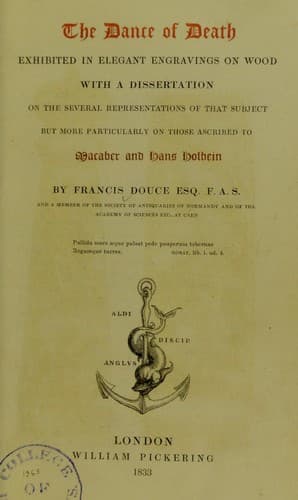
The Dance of Death: Exhibited in Elegant Engravings on Wood with a Dissertation on the Several Representations of that Subject but More Particularly on Those Ascribed to Macaber and Hans HolbeinDouce, Francis
History
The Dance of Death: Exhibited in Elegant Engravings on Wood with a Dissertation on the Several Representations of that Subject but More Particularly on Those Ascribed to Macaber and Hans Holbein
Douce, Francis
Bible. Old Testament -- Illustrations; Dance of death
A figure of Death as a naked old man with a long beard. He leans on a
pedestal, on which are placed a scull and an hour-glass, and with his left
hand draws towards him a draped female, who holds a globe in her left
hand. At the bottom of the print, MORS OMNIA MVTAT, with the unknown
monogram [monogram: BAD]. Upright, 5 inches by 2-3/4. It is a very rare
print on copper, not mentioned by Bartsch.
A small anonymous wood print of Death playing on a vielle, or beggar's
lyre.
An ancient anonymous copper engraving of Death standing on a bier, and
laying hands upon a youth over whom are the words, "Ach got min sal ich,"
and over Death, "hie her by mich." Both inscriptions on labels. Bartsch,
x. p. 54, No. 30.
An allegorical engraving on copper by Cuerenhert, after Martin Heemskirk,
1550. A naked man bestrides a large sack of money, on which a figure or
statue of Hope is standing. Death with one hand levels his dart at the
terrified man, and holds a circle in the other. The money is falling from
the sack, and appears to have demolished the hour-glass of Death. Upright,
11 inches by 8. At bottom, these lines:
Maer als hemdie eininghe doot comt voer ogen
Dan vint hii hem doer üdele hope bedrogen.
There is a smaller copy of it.
A circular engraving, two inches diameter, of a pair of lovers in a
garden. The lady is playing on a harp, her companion's lute is on the
ground. They are accompanied by a fool, and Death behind is standing with
a dart in his hand ready for aim at the youthful couple.
A very large engraving on wood tinted in chiaroscuro. It represents a sort
of triumphal arch at the top of which is a Death's head, above, an
hour-glass between two arm bones, that support a stone; evidently borrowed
from the last cut of the arms of Death in the Lyons wood-cuts. Underneath,
the three Fates between obelisks crowned with Deaths' heads and crosses,
with the words [Greek: MNÊMONEUE APOPSYCHEIN] and ITER AD VITAM. In the
middle, a circle with eight compartments, in which are skeleton heads of a
pope, an emperor, &c. with mottoes. In the extremity of the circle, the
words "Post hoc autem judicium statutum est omnibus hominibus semel mori."
The above obelisks are supported by whole length figures of Death, near
which are shields with BONIS BONA and MALIS MALA. On the pedestals that
support the figures of Death are shields inscribed MEMENTO MORI and
MEMORARE NOVISSIMA. Underneath the circle, a sort of table monument with
Death's head brackets, and on its plinth a sceptre, cardinal's cross,
abbot's crozier, a vessel with money, and two books. Between the brackets,
in capitals:
TRIA SUNT VERE
QVÆ ME FACIVNT
FLERE.
And underneath in italics:
Primum quidem durum, quia scio me moriturum.
Secundum vero plango, quia moriar, et nescio quando.
Tertium autem flebo, quia nescio ubi manebo.
Public-domain text, read in full here on John Shaqi.
Reviews
Reviews
No reviews yet
Be the first to share your thoughts on this work.
Elsewhere in the archive
Join the Discussion
Join the discussion
Sign in to leave a comment or review.
Sign InorCreate an account