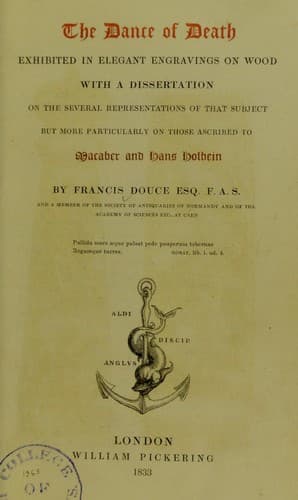
The Dance of Death: Exhibited in Elegant Engravings on Wood with a Dissertation on the Several Representations of that Subject but More Particularly on Those Ascribed to Macaber and Hans HolbeinDouce, Francis
History
The Dance of Death: Exhibited in Elegant Engravings on Wood with a Dissertation on the Several Representations of that Subject but More Particularly on Those Ascribed to Macaber and Hans Holbein
Douce, Francis
Bible. Old Testament -- Illustrations; Dance of death
It is very well known that the use of initial or capital letters,
especially with figures of any kind, is not coeval with the invention of
printing. It was some time before they were introduced at all, a blank
being left, or else a small letter printed for the illuminators to cover
or fill up, as they had been accustomed to do in manuscripts; for,
although the art of printing nearly put an end to the occupation of that
ingenious class of artists, they continued to be employed by the early
printers to decorate their books with elegant initials, and particularly
to illuminate the first pages of them with beautiful borders of foliage or
animals, for the purpose of giving them the appearance of manuscripts.
It has more than once been most erroneously asserted by bibliographers and
writers on typography, that Erhard Ratdolt, a printer at Venice, was the
first person who made use of initial letters about the year 1477; for
instances are not wanting of their introduction into some of the earliest
printed books. Among the latter the most beautiful specimen of an
ornamented capital letter is the B in the Psalter of 1457, of which Dr.
Dibdin has given a very faithful copy in vol. I. p. 107, of the
Bibliotheca Spenceriana. This truly elegant letter seems to have been
regarded as the only one of its kind; but, in a fragment of an undescribed
missal in folio, printed in the same type as the above-mentioned Psalter,
there is an equally beautiful initial T, prefixed to the "Te igitur"
canon of the mass. It is ornamented with flowers and foliage, and in both
these precious volumes there are many other smaller capitals, but whether
printed with the other type, or afterwards stamped, may admit of some
doubt. This unique and valuable fragment is in the collection of the
present writer.
As the art of printing advanced, the initial letters assumed every
possible variety of form, with respect to the subjects with which they
were ornamented. Incidents from scripture and profane history, animals of
every kind, and the most ludicrous grotesques, constitute the general
materials; nor has the Dance of Death been forgotten. It was first
introduced into the books printed at Basle by Bebelius and Cratander about
the year 1530, and for one or the other of these celebrated printers an
alphabet of initial letters was constructed, which, in elegance of design
and delicacy of engraving, have scarcely ever been equalled, and certainly
never exceeded. Whether they were engraved in relief on blocks of type or
printer's metal, in the manner of wood-cutting, or executed in wood in the
usual manner, is a matter of doubt, and likely to remain so. They may, in
every point of view be regarded as the chef d'oeuvre of ancient block
engraving, and to copy them successfully at this time might require the
utmost efforts of such artists as Harvey, Jackson, and Byfield.[134]
Public-domain text, read in full here on John Shaqi.
Reviews
Reviews
No reviews yet
Be the first to share your thoughts on this work.
Elsewhere in the archive
Join the Discussion
Join the discussion
Sign in to leave a comment or review.
Sign InorCreate an account