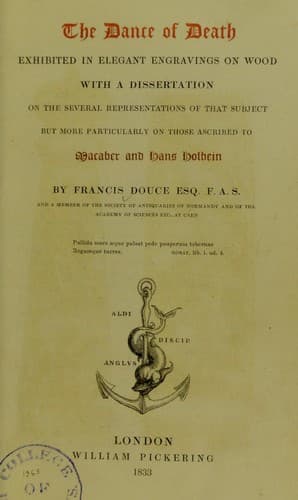
The Dance of Death: Exhibited in Elegant Engravings on Wood with a Dissertation on the Several Representations of that Subject but More Particularly on Those Ascribed to Macaber and Hans HolbeinDouce, Francis
History
The Dance of Death: Exhibited in Elegant Engravings on Wood with a Dissertation on the Several Representations of that Subject but More Particularly on Those Ascribed to Macaber and Hans Holbein
Douce, Francis
Bible. Old Testament -- Illustrations; Dance of death
But they were not only used at Basle by Bebelius Isingrin and Cratander,
but also at Strasburg by Wolfgang Cephaleus, and probably by other
printers; because in an edition of Huttichius's "Romanorum principum
effigies," printed by Cephaleus at Strasburg in 1552, they appear in a
very worn and much used condition. In his Greek Bible of 1526, near half
the alphabet were used, some of them by different hands.
They were separately published in a very small volume without date, each
letter being accompanied with appropriate scriptural allusions taken from
the Vulgate Bible.
They were badly copied, and with occasional variations, for books printed
at Strasburg by J. Schott about 1540. Same size as the originals. The same
initials were used by Henry Stainer of Augsburg in 1530.
Schott also used two other sets of a larger size, the same subjects with
variations, and which occur likewise in books printed at Frankfort about
1550 by Cyriacus Jacob.
Christopher Froschover, of Zurich, used two alphabets with the Dance of
Death. In Gesner's "Bibliotheca Universalis," printed by him in 1545,
folio, he used the letters A. B. C. in indifferent copies of the originals
with some variation. In a Vulgate Bible, printed by him in 1544, he uses
the A and C of the same alphabet, and also the following letters, with
different subjects, viz. F. Death blowing a trumpet in his left hand, with
the right seizes a friar holding his beads and endeavouring to escape. O.
Death and the Swiss soldier with his battle-axe; and, S. a queen between
two Deaths, one of whom leads her, the other holds up her train. The
Gesner has also a Q from the same alphabet of Death and the nun. This
second alphabet is coarsely engraved on wood, and both are of the same
size as the originals.
In Francolin's "Rerum præclare gestarum, intra et extra moenia civitatis
Viennensis, pedestri et equestri prælio, terra et aqua, elapso Mense Junio
Anni Domini MDLX. elegantissimis iconibus ad vivum illustratarum, in
laudem et gloriam sere. poten. invictissimique principis et Domini, Domini
Ferdinandi electi Roma: imperatoris, &c. Vienna excudebat Raphael
Hofhalter," at fo. xxii. b. the letter D is closely copied in wood from
the original, and appears to have been much used. This very rare work is
extremely interesting for its large and spirited etchings of the various
ceremonies on the above occasion, but more particularly for the
tournaments. It is also valuable for the marks of the artists, some of
which are quite unknown.
Public-domain text, read in full here on John Shaqi.
Reviews
Reviews
No reviews yet
Be the first to share your thoughts on this work.
Elsewhere in the archive
Join the Discussion
Join the discussion
Sign in to leave a comment or review.
Sign InorCreate an account