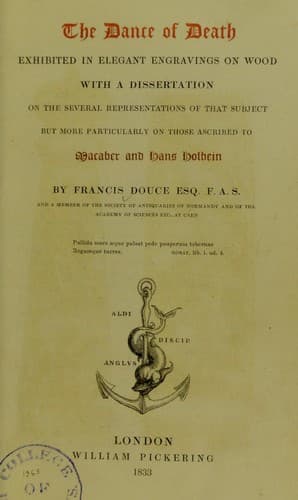
The Dance of Death: Exhibited in Elegant Engravings on Wood with a Dissertation on the Several Representations of that Subject but More Particularly on Those Ascribed to Macaber and Hans HolbeinDouce, Francis
History
The Dance of Death: Exhibited in Elegant Engravings on Wood with a Dissertation on the Several Representations of that Subject but More Particularly on Those Ascribed to Macaber and Hans Holbein
Douce, Francis
Bible. Old Testament -- Illustrations; Dance of death
on one side only of the paper; and refers to twenty-one of them in the
cabinet of M. Otto, of Leipsig, but without stating any letter-press as
belonging to them, or regarding them as a part of any German edition of
the work.
In the public library of Basle there are proof impressions, on four
leaves, of all the cuts which had appeared in the edition of 1538, except
that of the astrologer. Over each is the name of the subject printed in
German, and without any verses or letter-press whatever at bottom.
It is here necessary to mention that the first known edition in which
these cuts were used, namely, that of 1538, was accompanied with French
verses, descriptive of the subjects. In an edition that soon afterwards
appeared, these French verses were translated into Latin by George
Æmylius, a _German_ divine; and in another edition, published at Basle, in
1554, the Latin verses were continued. In both these cases, had there been
any former _German verses_, would they not have been retained in
preference?
There is a passage, however, in Gesner's Pandectæ, a supplemental volume
of great rarity to his well-known Bibliotheca, that slightly adverts to a
German edition of this work, and at the same time connects Holbein's name
with it. It is as follows: "Imagines mortis expressæ ab optimo pictore
Johanne Holbein cum epigrammatibus Geo. Æmylii, excusæ Francofurti et
Lugduni apud Frellonios, quorum editio plures habet picturas. Vidi etiam
cum metris Gallicis et _Germanicis si bene memini_."[100] But Gesner
writes from imperfect recollection only, and specifies no edition in
German. It is most probable that he refers to an early copy of the cuts on
a larger scale with a good deal of text in German, and printed and perhaps
engraved by Jobst Denecker, at Augsburg, 1544, small folio.
Public-domain text, read in full here on John Shaqi.
Reviews
Reviews
No reviews yet
Be the first to share your thoughts on this work.
Elsewhere in the archive
Join the Discussion
Join the discussion
Sign in to leave a comment or review.
Sign InorCreate an account