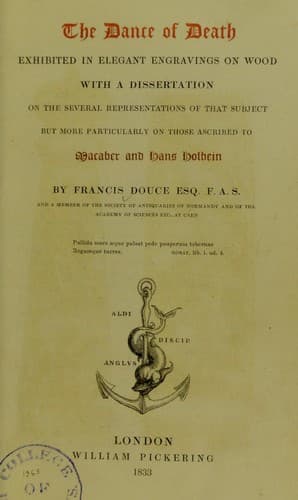
The Dance of Death: Exhibited in Elegant Engravings on Wood with a Dissertation on the Several Representations of that Subject but More Particularly on Those Ascribed to Macaber and Hans HolbeinDouce, Francis
History
The Dance of Death: Exhibited in Elegant Engravings on Wood with a Dissertation on the Several Representations of that Subject but More Particularly on Those Ascribed to Macaber and Hans Holbein
Douce, Francis
Bible. Old Testament -- Illustrations; Dance of death
Doubts have arisen whether the above can be regarded as the first edition
of these justly celebrated engravings in the form of a volume accompanied
with text. In the "Notices sur les graveurs," Besançon, 1807, 8vo. a work
ascribed to M. Malpé,[99] it is stated to have been originally published
at Basle in 1530; and in M. Jansen's "Essai sur l'origine de la gravure,"
&c. Paris, 1808, 8vo. a work replete with plagiarisms, and the most
glaring mistakes, the same assertion is repeated. This writer adds, but
unsupported by any authority, that soon afterwards another edition
appeared with Flemish verses. Both these authors, following their blind
leader Papillon, have not ventured to state that they ever saw this
supposed edition of 1530, and it may indeed be asked, who has? Or in what
catalogue of any library is it recorded? Malpé acknowledges that the
earliest edition he had seen was that of 1538. M. Fuseli, in his edition
of Pilkington's Dictionary of Painters, has appended a note to the article
for Hans Holbein, where, alluding perhaps to the former edition of the
present dissertation, he remarks, that "Holbein's title to the Dance of
Death would not have been called in question, had the ingenious author of
the dissertation on that subject been acquainted with the German edition."
This gentleman seems, however, to have inadvertently forgotten a former
opinion which he had given in one of his lectures, where he says, "The
scrupulous precision, the high finish, and the Titianesque colour of Hans
Holbein would make the least part of his excellence, if his right to that
series of emblematic groups known under the name of Holbein's Dance of
Death had not, of late, been too successfully disputed." M. Fuseli would
have rendered some service to this question by favouring us with an
explicit account of the above German edition, if he really intended by it
a complete work; but it is most likely that he adverted to some separate
impressions of the cuts with printed inscriptions on them, but which are
only the titles of the respective characters or subjects. To such
impressions M. Malpé has certainly referred, adding that they have, at
top, passages from the Bible in German, and verses at bottom in the same
language. Jansen follows him as to the verses at bottom only. Now, on
forty-one of these separate impressions, in the collection of the accurate
and laborious author of the best work on the origin and early history of
engraving that has ever appeared, and on several others in the present
writer's possession, neither texts of scripture, nor verses at bottom, are
to be found, and nothing more than the above-mentioned German titles of
the characters. M. Huber, in his "Manuel des curieux et des amateurs de
l'art," vol. i. p. 155, after inaccurately stating that Holbein _engraved_
these cuts, proceeds to observe, that in order to form a proper judgment
of their merit, it is necessary to see the earliest impressions, printed
Public-domain text, read in full here on John Shaqi.
Reviews
Reviews
No reviews yet
Be the first to share your thoughts on this work.
Elsewhere in the archive
Join the Discussion
Join the discussion
Sign in to leave a comment or review.
Sign InorCreate an account