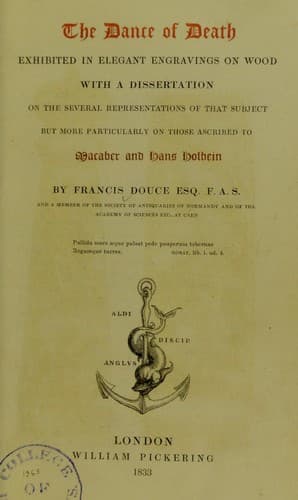
The Dance of Death: Exhibited in Elegant Engravings on Wood with a Dissertation on the Several Representations of that Subject but More Particularly on Those Ascribed to Macaber and Hans HolbeinDouce, Francis
History
The Dance of Death: Exhibited in Elegant Engravings on Wood with a Dissertation on the Several Representations of that Subject but More Particularly on Those Ascribed to Macaber and Hans Holbein
Douce, Francis
Bible. Old Testament -- Illustrations; Dance of death
In the edition of 1538 there is a dedication, not in any of the others,
and of very considerable importance. It is a pious, quaint, and jingling
address to Jeanne de Touszele, Abbess of the convent of St. Peter, at
Lyons, in which the author, whose name is obscurely stated to be Ouzele,
compliments the good lady as the pattern of true religion, from her
intimate acquaintance with the nature of Death, rushing, as it were, into
his hands, by her entrance into the sepulchre of a cloister. He enlarges
on the various modes of representing the mortality of human nature, and
contends that the image of Death has nothing terrific in the eyes of the
Christian. He maintains that there is no better method of depicting
mortality than by a dead person, especially by those images which so
frequently occur on sepulchral monuments. Adverting then to the figures in
the present work he _regrets the death of him who has here conceived
[imaginé] such elegant designs, greatly exceeding all other patterns of
the kind, in like manner as the paintings of Apelles and Zeuxis have
surpassed those of modern times_. He observes that these funereal
histories, accompanied by their grave descriptions in rhyme, induce the
admiring spectators to behold the dead as alive, and the living as dead;
which leads him to believe that Death, apprehensive lest this admirable
_painter_ should exhibit him so lively that he would no longer be feared
as Death, and that he should thereby become immortal himself, had hastened
his days to an end, and thus prevented him from completing many other
figures, which _he_ had already _designed_, especially that of the carman
crushed and wounded beneath his demolished waggon, the wheels and horses
of which are so frightfully overthrown that as much horror is excited in
beholding their downfall, as pleasure in contemplating the lickerishness
of one of the Deaths, who is clandestinely sucking with a reed the wine in
a bursting cask.[101] That in these imperfect subjects no one had dared to
put the finishing hand, on account of the boldness of their outline,
shadow, and perspective, _delineated_ in so graceful a manner, that by its
contemplation one might indulge either in a joyful sorrow, or a melancholy
pleasure. "Let antiquaries then," says he, "and lovers of ancient imagery
discover any thing comparable to these figures of Death, in which we
behold the Empress of all living souls from the creation, trampling over
Cæsars, Emperors, and Kings, and with her scythe mowing down the
tyrannical heroes of the earth." He concludes with admonishing the Abbess
to take in good part this his sad but salutary present, and to persuade
her devout nuns not only to keep it in their cells and dormitories, but in
the cabinet of their memory, therein pursuing the counsel of St. Jerom,
&c.
Public-domain text, read in full here on John Shaqi.
Reviews
Reviews
No reviews yet
Be the first to share your thoughts on this work.
Elsewhere in the archive
Join the Discussion
Join the discussion
Sign in to leave a comment or review.
Sign InorCreate an account