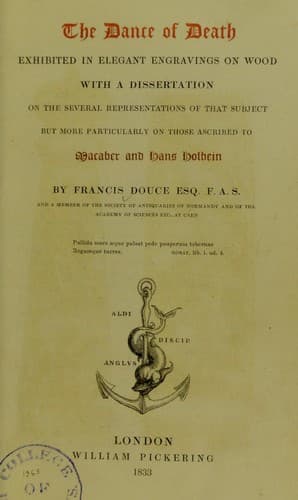
The Dance of Death: Exhibited in Elegant Engravings on Wood with a Dissertation on the Several Representations of that Subject but More Particularly on Those Ascribed to Macaber and Hans HolbeinDouce, Francis
History
The Dance of Death: Exhibited in Elegant Engravings on Wood with a Dissertation on the Several Representations of that Subject but More Particularly on Those Ascribed to Macaber and Hans Holbein
Douce, Francis
Bible. Old Testament -- Illustrations; Dance of death
The singularity of this curious and interesting dedication is deserving of
the utmost attention. It seems very strongly, if not decisively, to point
out the edition to which it is prefixed, as the first; and what is of
still more importance, to deprive Holbein of any claim to the _invention_
of the work. It most certainly uses such terms of art as can scarcely be
mistaken as conveying any other sense than that of _originality in
design_. There cannot be words of plainer import than those which describe
the painter, as he is expressly called, _delineating_ the subjects, and
leaving several of them unfinished: and whoever the artist might have
been, it clearly appears that he was not living in 1538. Now it is well
known that Holbein's death did not take place before the year 1554, during
the plague which ravaged London at that time. If then the expressions used
in this dedication signify any thing, it may surely be asked what becomes
of any claim on the part of Holbein to the designs of the work in
question, or does it not _at least_ remain in a situation of doubt and
difficulty?
It is, however, with no small hesitation that the author of the present
dissertation still ventures to dispute, and even to deny, the title of
Holbein to the invention of this Dance of Death, in opposition to his
excellent and valuable friend Mr. Ottley, whose opinion in matters of
taste, as well as on the styles of the different masters in the old
schools of painting and engraving may be justly pronounced to be almost
oracular. This gentleman has thus expressed himself: "It cannot be denied
that were there nothing to oppose to this passage, it would seem to
constitute very strong evidence that Holbein, who did not die until the
year 1554, was not the author of the designs in question; but I am firmly
persuaded that it refers in reality, not to the designer, but to the
artist who had been employed, under his direction, to engrave the designs
in wood, and whose name, there appears reason to believe, was Hans
Lutzenberger.[102] Holbein, I am of opinion, had, shortly before the year
1538, sold the forty-one blocks which had been some time previously
executed, to the booksellers of Lyons, and had at the same time given him
a promise of others which he had lately designed, as a continuation of the
series, and were then in the hands of the wood-engraver. The
wood-engraver, I suppose, died before he had completed his task, and the
correspondent of the bookseller, who had probably deferred his publication
in expectation of the new blocks, wrote from Basle to Lyons to inform his
friend of the disappointment occasioned by the artist's death. It is
probable that this information was not given very circumstantially, as to
the real cause of the delay, and that the person who wrote the dedication
of the book might have believed the designer and engraver to be one and
the same person: it is still more probable that he thought the distinction
Public-domain text, read in full here on John Shaqi.
Reviews
Reviews
No reviews yet
Be the first to share your thoughts on this work.
Elsewhere in the archive
Join the Discussion
Join the discussion
Sign in to leave a comment or review.
Sign InorCreate an account