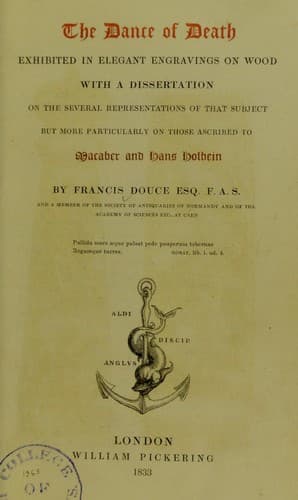
The Dance of Death: Exhibited in Elegant Engravings on Wood with a Dissertation on the Several Representations of that Subject but More Particularly on Those Ascribed to Macaber and Hans HolbeinDouce, Francis
History
The Dance of Death: Exhibited in Elegant Engravings on Wood with a Dissertation on the Several Representations of that Subject but More Particularly on Those Ascribed to Macaber and Hans Holbein
Douce, Francis
Bible. Old Testament -- Illustrations; Dance of death
III. "Imagines Mortis. His accesserunt, Epigrammata, è Gallico idiomate à
Georgio Æmylio in Latinum translata. Ad hæc, Medicina animæ, tam iis qui
firma, quàm qui adversa corporis valetudine præditi sunt, maximè
necessaria. Ratio consolandi ob morbi gravitatem periculosè decumbentes.
Quæ his addita sunt, sequens pagina commonstrabit. Lugduni, sub scuto
Coloniensi, 1545." With the device of the crab and the butterfly. At the
end, "Lugduni Excudebant Joannes et Franciscus Frellonii fratres," 1545,
12mo. The whole of the text is in Latin, and translated, except the
scriptural passages, from the French, by George Æmylius, as he also states
in some verses at the beginning; but several of the mottoes at bottom are
different and enlarged. It has forty-two cuts, the additional one,
probably not by the former artist, being that of the beggar sitting on the
ground before an arched gate: extremely fine, particularly the beggar's
head. This subject has no connection with the Dance of Death, and is
placed in another part of the volume, though in subsequent editions
incorporated with the other prints. The "Medicina animæ" is very different
from the French one. There is some reason for supposing that the Frellons
had already printed an edition with Æmylius's text in 1542. This person
was an eminent German divine of Mansfelt, and the author of many pious
works. In the present edition the first cut of the creation exhibits a
crack in the block from the top to the bottom, but it had been in that
state in 1543, as appears from an impression of it in Holbein's Bible of
that date. It is found so in all the subsequent editions of the present
work, with the exception of those in Italian of 1549 and in the Bible of
1549, in which the crack appears to have been closed, probably by
cramping; but the block again separated afterwards.
This edition is of some importance with respect to the question as to the
priority of the publication of the work in France or Germany, or, in other
words, whether at Lyons or Basle. It is accompanied by some lines
addressed to the reader, which begin in the following manner:
Accipe jucundo præsentia carmina vultu,
Seu Germane legis, sive ea Galle legis:
In quibus extremæ qualis sit mortis imago
Reddidit imparibus Musa Latina modis
_Gallia quæ dederat lepidis epigrammata verbis
Teutona convertens est imitata manus._
Da veniam nobis doctissime Galle, videbis
Versibus appositis reddita si qua parum.
Now, had the work been originally published in the German language,
Æmylius, himself a German, would, as already observed, scarcely have
preferred a French text for his Latin version. This circumstance furnishes
likewise, an argument against the supposed existence of German verses at
the bottom of the early impressions of the cuts already mentioned.
Public-domain text, read in full here on John Shaqi.
Reviews
Reviews
No reviews yet
Be the first to share your thoughts on this work.
Elsewhere in the archive
Join the Discussion
Join the discussion
Sign in to leave a comment or review.
Sign InorCreate an account