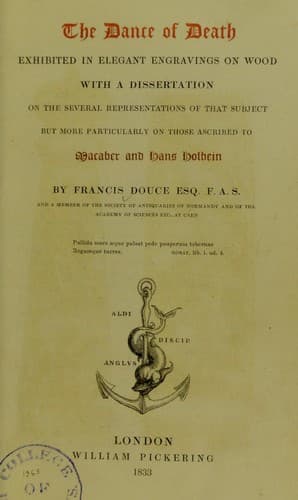
The Dance of Death: Exhibited in Elegant Engravings on Wood with a Dissertation on the Several Representations of that Subject but More Particularly on Those Ascribed to Macaber and Hans HolbeinDouce, Francis
History
The Dance of Death: Exhibited in Elegant Engravings on Wood with a Dissertation on the Several Representations of that Subject but More Particularly on Those Ascribed to Macaber and Hans Holbein
Douce, Francis
Bible. Old Testament -- Illustrations; Dance of death
are not warranted in supposing the rest of them to have been engraved by a
different artist.
It will perhaps not be deemed an unimportant digression to introduce a few
remarks concerning the owner of the above monogram. It is by no means
clear whether he was a designer or an engraver, or even both. There is a
chiaroscuro print of a group of saints, engraved by Peter Kints, an
obscure artist, with the name of Antony Sallaerts at length, and the mark.
Here he appears as a designer. M. Malpé, the Besançon author of "Notices
sur les graveurs," speaks of Sallaerts as an excellent painter, born at
Brussels about 1576, which date cannot possibly apply to the artist in
question; but at the same time, he adds, that he is said to have engraved
on wood the cuts in a little catechism printed at Antwerp that have the
monogram [monogram: SA]. These are certainly very beautiful, in accordance
with many others with the same mark, and very superior in design to those
which have it in the "Imagines Mortis." M. Malpé has also an article for
Antony Silvyus or Silvius, born at Antwerp about 1525, and he mentions
several books with engravings and the mark in question, which he gives to
the same person. M. Brulliot expresses a doubt as to this artist; but it
is very certain there was a family of that name, and surnamed, or at least
sometimes called, Bosche or Bush, which indeed is more likely to have been
the real Flemish name Latinized into Silvius. Foppens[119] has mentioned
an Antony Silvius, a schoolmaster at Antwerp, in 1565, and several other
members of this family. Two belonging to it were engravers, and another a
writing master.
Whether the artist in question was a Sallaerts or a Silvius, it is certain
that Plantin, the celebrated printer, employed him to decorate several of
his volumes, and it is to be regretted that an unsuccessful search has
been made for him in Plantin's account books, that were not long since
preserved, with many articles belonging to him, in his house at Antwerp.
His mark also appears in several books printed in England during the reign
of Elizabeth, and particularly on a beautiful set of initial letters, some
of which contain the story of Cupid and Psyche, from the supposed designs
by Raphael, and other subjects from Ovid's Metamorphoses: these have been
counterfeited, and perhaps in England. The initial [monogram: G], in this
alphabet, with the subject of Leda and the swan, was inadvertently
prefixed to the sacred name at the beginning of St. Paul's Epistle to the
Hebrews in the Bishop's Bible, printed by Rd. Jugge in 1572, and in one of
his Common Prayer Books. An elegant portrait of Edward VI. with the mark
[monogram: SA] is likewise on Jugge's edition of the New Testament, 1552,
4to. and there is reason to believe that Jugge employed this artist, as
the same monogram appears on a cut of his device of the pelican.
Public-domain text, read in full here on John Shaqi.
Reviews
Reviews
No reviews yet
Be the first to share your thoughts on this work.
Elsewhere in the archive
Join the Discussion
Join the discussion
Sign in to leave a comment or review.
Sign InorCreate an account