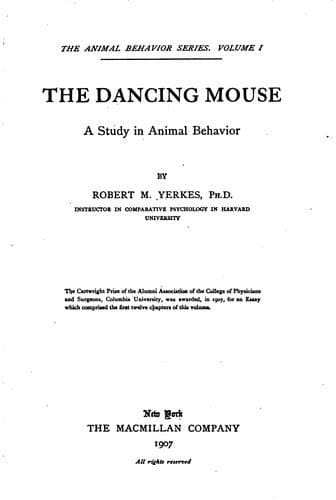
The Dancing Mouse: A Study in Animal BehaviorYerkes, Robert Mearns
Science
The Dancing Mouse: A Study in Animal Behavior
Yerkes, Robert Mearns
Animal behavior; Dancing mice
Immediately after the brightness series, the influence of making first one
color, then the other, the brighter was studied. Throughout series 9 the
brightness value of the left box remained 3 candle meters, that of the
right side 1800 candle meters. Number 2 was so badly confused by this
change that his mistakes in this series numbered 12; No. 5 made only 4
incorrect choices. Then series after series was given under widely
differing conditions of illumination. The expression "mixed values," which
occurs in Table 26 in connection with series 14 to 22 inclusive, means
that the brightnesses of the green and the red boxes were changed from
test to test in much the way indicated by the sample series of Table 25.
In view of the results of these 22 series, 320 tests for each of two mice,
it is evident that the dancer is able to discriminate visually by some
other factor than brightness. What this factor is I am not prepared to
say. It may be something akin to our color experience, it may be distance
effect. No other possibilities occur to me.
Table 26 shows that discrimination was relatively easy for Nos. 2 and 5
with green at 3 candle meters and red at 1800. That their discrimination
was made on the basis of the greater brightness of the red, instead of on
the basis of color, is indicated by the results of the brightness check
series 8a. Increase in the brightness of the green rendered discrimination
difficult for a time, but it soon improved, and by no changes in the
relative brightness of the two colors was it possible to prevent correct
choice.
In addition to giving point to the statement that red appears darker to
the dancer than to us, the above experiment shows that the animals depend
upon brightness when they can, and that their ability to discriminate
color differences is extremely poor, so poor indeed that it is doubtful
whether their records are better than those of a totally color blind
person would be under similar conditions. Surely in view of such results
it is unsafe to claim that the dancer possesses color vision similar to
ours.
Perfectly trained as they were, by their prolonged green-red tests, to
choose the green, or what in mouse experience corresponds to our green,
Nos. 2 and 5 offered an excellent opportunity for further tests of blue-
green discrimination. For in view of their previous training there should
be no question of preference for the blue or of a tendency to depend upon
brightness in the series whose results constitute Table 27.
TABLE 27
BLUE-GREEN TESTS
NO. 2 NO. 5
SERIES DATE BRIGHTNESS VALUES RIGHT WRONG RIGHT WRONG
(BLUE) (GREEN) (BLUE) (GREEN)
Public-domain text, read in full here on John Shaqi.
Reviews
Reviews
No reviews yet
Be the first to share your thoughts on this work.
Elsewhere in the archive
Join the Discussion
Join the discussion
Sign in to leave a comment or review.
Sign InorCreate an account