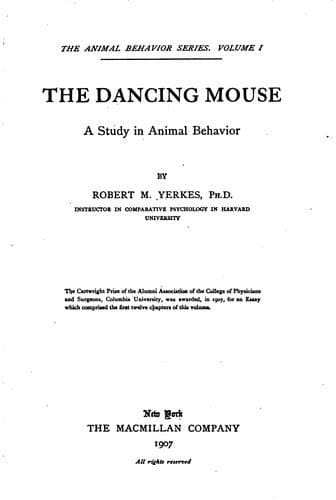
The Dancing Mouse: A Study in Animal BehaviorYerkes, Robert Mearns
Science
The Dancing Mouse: A Study in Animal Behavior
Yerkes, Robert Mearns
Animal behavior; Dancing mice
This series of tests with labyrinth B, whose several purposes may best be
explained in connection with the various kinds of tests enumerated below,
consisted of:
I. A preliminary test in which the dancer was permitted to wander about in
the labyrinth, without being shocked, until it finally escaped to the
nest-box by way of the exit. Thus the animal was given an opportunity to
discover that escape from the maze was possible.
II. This was immediately followed by a series of tests at the rate of
about one per minute, with an electric shock as punishment for every
mistake. This was continued without interruption until the path had been
followed without error five times in succession.
III. The labyrinth was now moved about 3 cm. to one side so that it
covered a new floor area, and a test was given for the purpose of
ascertaining whether the mouse had been following a trail on the floor.
IV. Tests with smoked paper on the floor were now alternated with tests in
which the floor was plain. The alternation was rendered necessary by the
fact that the paper was laid over the electric wires and therefore
prevented the punishment of mistakes. The purpose of these tests was to
discover whether the smoked paper, which was an essential condition for
the next test, was itself a disturbing condition. These tests were
continued until the animal had followed the path correctly, despite the
smoked paper, twice in succession.
V. The electric lights were now turned out and tests were given in total
darkness, with smoked paper on the floor as a means of obtaining a record
of the number of errors. These tests were continued until the path had
been followed once correctly.
VI. The labyrinth was now thoroughly washed with warm water, to which a
little kerosene had been added, and quickly dried over a steam radiator.
This usually necessitated a delay of about five minutes. As soon as the
labyrinth was dry, tests were given to discover whether the odors of the
various passages had been serving as important guiding conditions. These
tests were continued until the path had been followed once without error.
VII. A final test in darkness completed the series.
As it was not possible for the observer to watch the animal and thus to
count the number of mistakes which it made in total darkness, the simple
method of placing a piece of smoked paper on the floor of the labyrinth
was used. The mouse left a graphic record of its path on the paper and
from this the number of errors could be ascertained. In the tests now to
be described the smoked paper was placed upon the electric wires, but
later a form of electric labyrinth was devised in which it was underneath
and therefore did not interfere with the electric shock.
Public-domain text, read in full here on John Shaqi.
Reviews
Reviews
No reviews yet
Be the first to share your thoughts on this work.
Elsewhere in the archive
Join the Discussion
Join the discussion
Sign in to leave a comment or review.
Sign InorCreate an account