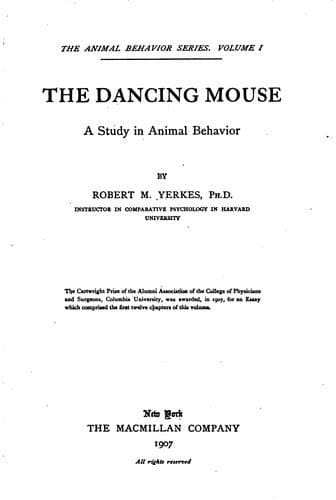
The Dancing Mouse: A Study in Animal BehaviorYerkes, Robert Mearns
Science
The Dancing Mouse: A Study in Animal Behavior
Yerkes, Robert Mearns
Animal behavior; Dancing mice
In the experiments a mouse was permitted to enter the maze from a small
box which had been placed by the experimenter at _I_, and an accurate
record was kept of the number of errors which it made in finding its way
from entrance to exit, and of the time occupied. Each of five dancers was
given 31 tests in this labyrinth. The number of tests per day varied, as
is indicated in Table 36, from 1 to 4. The results of the tests, so far as
errors and times are in question, appear in the table. _T_ at the head of
a column is an abbreviation for time, _E_ for errors.
The dancers did not learn to escape from this labyrinth easily and
quickly. In fact, the average time of the thirty-first test (198") is
considerably longer than that of the first (130"). The number of errors
decreased, it is true, but even for the last test it was 6.6 as compared
with only a little more than twice that number for the first test. The
last column of the table furnishes convincing proof of the truth of the
statement that the animals did not acquire a perfect labyrinth-A habit.
Was this due to inability to learn so complex a path, or to the fact that
the method is not adapted to their nature? Observation of the behavior of
the mice in the experiments enables me to say with certainty that there
was no motive for escape sufficiently strong to establish a habit of
following the direct path. Often, especially after a few experiences in
the maze, a dancer would wander back and forth in the alleys and central
courts, dancing much of the time and apparently exploring its surroundings
instead of persistently trying to escape. This behavior, and the time and
error results of the accompanying table, lead me to conclude that the
labyrinth method, as it has been employed in the study of the intelligence
of several other mammals, is not a satisfactory test of the ability of the
dancer to profit by experience. That the fault is not in the labyrinth
itself is proved by the results which I obtained with common mice.
TABLE 36
RESULTS OF LABYRINTH A TESTS WITH DANCERS
AVERAGE
TEST DATE No. 1000 No. 2 No. 6 No. 4 No. 5 FOR ALL
1905
T E T E T E T E T E T E
Public-domain text, read in full here on John Shaqi.
Reviews
Reviews
No reviews yet
Be the first to share your thoughts on this work.
Elsewhere in the archive
Join the Discussion
Join the discussion
Sign in to leave a comment or review.
Sign InorCreate an account