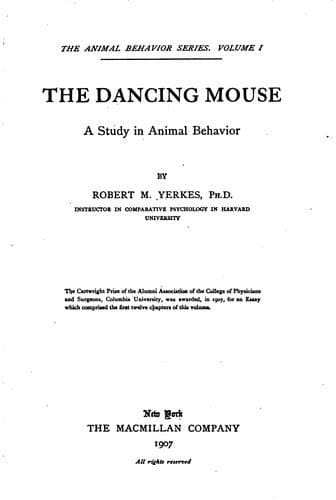
The Dancing Mouse: A Study in Animal BehaviorYerkes, Robert Mearns
Science
The Dancing Mouse: A Study in Animal Behavior
Yerkes, Robert Mearns
Animal behavior; Dancing mice
more satisfactory means of measuring the rapidity of habit formation.
[Illustration: FIGURE 27--A record sheet, showing the plan of labyrinth C
(as made on the sheet by means of a rubber stamp) on which the
experimenter recorded the path followed by the mouse. This sample sheet
presents the path records for the first, fifth, tenth, and eleventh tests
of No. 2 in labyrinth C. 1, 2, 3, 4, 5 designate the several errors of the
labyrinth.]
On the basis of the supposition that a maze whose path was so complex that
the animal would not be likely to follow it correctly in the early trials
would be more to the purpose than either A or B, labyrinth C was devised.
As is shown in the plan of this maze, Figure 27, five mistakes in choice
of path were possible on the forward trip. These errors, as a rule, were
more difficult for the dancers to avoid than those of labyrinths A and B.
Those which are designated by the numerals 2, 3, and 4 were especially
difficult. Error 4 was much more troublesome for left whirlers than for
right whirlers because, after turning around abruptly at the entrance to
the blind alley, the former type of dancer almost always followed the side
wall of the maze so far that it missed the correct path. Undoubtedly the
various errors are not of the same value for different individuals; but it
would be extremely difficult, if not impossible, to devise a maze which
should be equally difficult for several normal individuals.
In order that records of the path followed by a mouse in test after test
might be kept with ease and accuracy by the experimenter, the plan of this
labyrinth, and also that of labyrinth D, were cast in rubber. The outlines
of labyrinths C and D which appear in Figures 27 and 28 respectively were
made with the rubber stamps which were thus obtained. Figure 27 is the
reproduction of a record sheet which presents the results of the first,
the fifth, the tenth, and the eleventh tests of No. 2 in labyrinth C. The
path followed by this individual in the first test was far too complex to
be traced accurately on the record sheet. The record therefore represents
merely the number of errors which was made in each region of the maze. For
the fifth test, and again for the tenth and the eleventh, the path was
recorded accurately. This simple device for making record blanks which can
readily be filled in at the time of the experiment should recommend itself
to all students of animal behavior.
In labyrinth C ten pairs of dancers were given continuous training tests
at the rate of one test per minute until they were able to follow the
direct path correctly. Because of the difficulty in learning this maze
perfectly, it was not demanded of the mice that they should follow the
path correctly several times in succession, but instead the training was
terminated after the first successful trip.
TABLE 39
RESULTS OF LABYRINTH-C EXPERIMENTS, WITH TWENTY DANCERS
MALES FEMALES
Public-domain text, read in full here on John Shaqi.
Reviews
Reviews
No reviews yet
Be the first to share your thoughts on this work.
Elsewhere in the archive
Join the Discussion
Join the discussion
Sign in to leave a comment or review.
Sign InorCreate an account