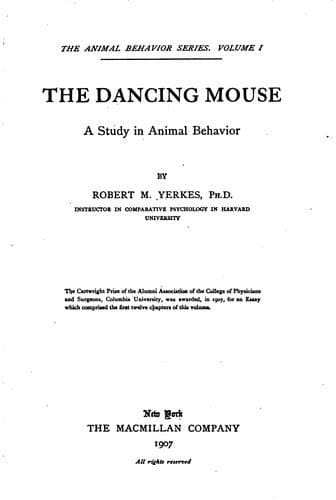
The Dancing Mouse: A Study in Animal BehaviorYerkes, Robert Mearns
Science
The Dancing Mouse: A Study in Animal Behavior
Yerkes, Robert Mearns
Animal behavior; Dancing mice
I have records for four generations in the 200 line and for three
generations in the 400 line.[1] As the results are practically the same
for each, I shall present the detailed records for the former group alone.
In Table 53 are to be found the number of errors made in successive series
of ten tests each by the various individuals of the 200 line which were
trained in this experiment. The most careful examination fails to reveal
any indication of the inheritance of a tendency to avoid the black box.
No. 240, in fact, chose the black box more frequently in the preference
series than did No. 210, and he required thirty more tests for the
establishment of a perfect habit than did No. 210. Apparently descent from
individuals which had thoroughly learned to avoid the black box gives the
dancer no advantage in the formation of a white-black discrimination
habit. There is absolutely no evidence of the inheritance of this
particular individually acquired form of behavior in the dancer.
[Footnote 1: This experiment was interrupted by the death of the animals
of both lines of descent.]
INDEX
Abnormal dancers.
Acquired forms of behavior.
Act, useless, repeated.
Activity, periods of.
Affirmation, choice by.
Age, peculiarities;
maximum age;
and intelligence.
Albino cat;
dog.
Alexander and Kreidl, young dancer;
behavior;
tracks of mice;
behavior in cyclostat;
behavior of white mouse and dancer;
structure of ear;
deafness.
Allen, G. M., drawing of dancer;
heredity in mice.
Alleys, width of, in labyrinths.
Amyl acetate for photometry.
Anatomy of dancer.
Animals, education of.
Appuun whistles.
Audition. _See_ Hearing.
Averages, dangers in.
Baginsky, B., model of ear of dancer.
Bateson, W., breeding experiments.
Behavior, of dancer;
inheritance of;
when blinded;
equilibration;
dizziness;
structural bases of;
of young;
changes in;
useless acts;
under experimental conditions;
in indiscriminable conditions;
value of sight;
in labyrinth experiments;
modifiability of;
history of;
explanations of;
individual differences in.
Blinded dancers, behavior of.
Blue-orange tests;
blue-red tests;
blue-green tests;
blue-green blindness.
Bradley papers.
Brain, structure of.
Breeding of dancers.
Brehm, A. E., "Tierleben".
Brightness vision;
preference;
check experiments;
relation to color vision.
Public-domain text, read in full here on John Shaqi.
Reviews
Reviews
No reviews yet
Be the first to share your thoughts on this work.
Elsewhere in the archive
Join the Discussion
Join the discussion
Sign in to leave a comment or review.
Sign InorCreate an account