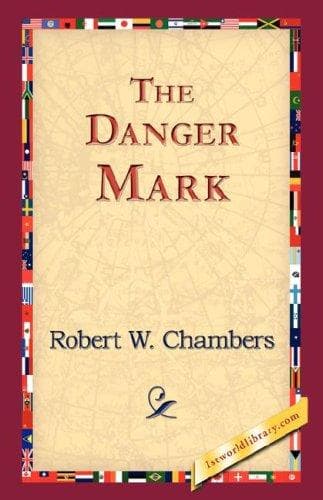
The Danger MarkChambers, Robert W. (Robert William)
General
The Danger Mark
Chambers, Robert W. (Robert William)
New York (N.Y.) -- Social life and customs -- Fiction
"Yes, to be sure, yes, to be sure!" piped the old beau. "How-de-do!
How-de-do-o-o! My son Jack and I motor every morning at this hour. It is
becoming a custom--he! he!--every day from ten to eleven--then a biscuit
and a glass of sherry--then a nap--te-he! Oh, yes, every day, Mr. Mallett,
rain or fair--then luncheon at one, and the cigarette--te-he!--and a
little sleep--and the drive at five! Yes, Mr. Mallett, it is the routine
of a very old man who knew your grandfather--and all his set--when the
town was gay below Bleecker Street! Yes, yes--te-he-he!"
Nervous spasms which passed as smiles distorted the younger Dysart's
visage; the aged beau offered his hand to Duane, who took it in silence,
his eyes fixed on the shrivelled, painted face:
"Your grandfather was a very fine man," he piped; "very fine! ve-ery
fine! And so I perceive is his grandson--te-he!--and I flatter myself
that my boy Jack is not unadmired--te-he-he!--no, no--not precisely
unnoticed in New York--the town whose history is the history of his own
race, Mr. Mallett--he is a good son to me--yes, yes, a good son. It is
gratifying to me to know that you are his friend. He is a good friend to
have, Mr. Mallett, a good friend and a good son."
Duane bent gently over the shrivelled hand.
"I won't detain you from your drive, Mr. Dysart. I hope you will have a
pleasant one. It is a pleasure to know my grandfather's old friends.
Good-bye."
And, erect, he hesitated a moment, then, for an old man's sake he held
out his hand to Jack Dysart, bidding him good-bye in a pleasant voice
pitched clear and decided, so that deaf ears might corroborate what
half-blind and peering eyes so dimly beheld.
Dysart walked to the door with him, waved the servant aside, and, laying
a shaking hand on the bronze knob, opened the door for his unbidden
guest.
As Duane passed him he said:
"Thank you, Mallett," in a voice so low that Duane was half-way to his
cab before he understood.
* * * * *
That day, and the next, and all that week he worked in his pitlike
studio. Through the high sky-window a cloudless zenith brooded; the heat
became terrific; except for the inevitable crush of the morning and
evening migration south and north, the streets were almost empty under a
blazing sun.
His father seemed to be physically better. Although he offered no
confidences, it appeared to the son that there was something a little
more cheerful in his voice and manner. It may have been only the
anticipation of departure; for he was going West in a day or two, and it
came out that Wilton was going with him.
The day he left, Duane drove him to the station. There was a private
car, the "Cyane," attached to the long train. Wilton met them, spoke
pleasantly to Duane; but Colonel Mallett did not invite his son to enter
the car, and adieux were said where they stood.
Public-domain text, read in full here on John Shaqi.
Reviews
Reviews
No reviews yet
Be the first to share your thoughts on this work.
Elsewhere in the archive
Join the Discussion
Join the discussion
Sign in to leave a comment or review.
Sign InorCreate an account