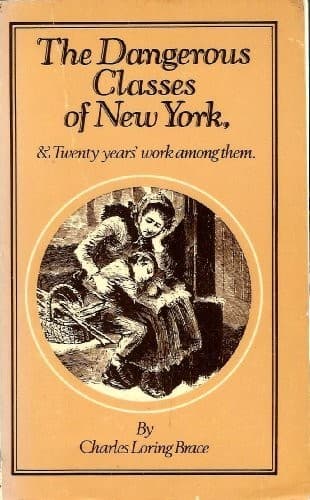
The Dangerous Classes of New York, and Twenty Years' Work Among ThemBrace, Charles Loring
History
The Dangerous Classes of New York, and Twenty Years' Work Among Them
Brace, Charles Loring
Child welfare -- New York (State) -- New York; New York (N.Y.) -- Social conditions; Poor -- New York (State) -- New York
"Coming up Chatham Street and bending your course to the left, you turn
into Baxter Street, a dark, damp, muddy street, forming one of the Five
Points. On each side of the way are stores of old clothes and
heterogeneous articles, kept by Polish and German Jews. Numerous
'Unredeemed Goods for Sale,' in the shape of coats, vests, and other
unmentionable garments, are suspended on wooden stands in front of the
doorways. There are also junk-stores, rags, bones, and old metal depots,
and two Italian groceries, one opposite the other. Advancing farther,
you reach the centre of the Five Points, synonymous of whatever is
degraded and degrading, loathsome and criminal. Hero Park Street runs
parallel to Chatham Street and crosses Baxter Street at right angles,
thus forming four of the Five Points. The fifth point is formed by the
junction of Worth Street, leading from this common centre in a northerly
direction. This locality is very dimly lighted, and the few lamps
scattered around only add to the repulsive nature of the place. The
pestiferous exhalations of the filthy streets, and not less filthy
shanties, inhabited by the lowest and most disreputable characters, are
disgusting beyond any description. Scattered over this neighborhood,
densely settled by the most depraved classes of all nationalities, there
lived, and still live, some fifteen hundred of the poorest class of
Italians, who traditionally cling to that locality. They are generally
from the Ligurian coasts, which are over-populated. When the farms
require working, the inhabitants usually have something to do; but, at
some seasons, want of employment compels them to turn elsewhere. Men,
women, and lads went in ordinary times to the largest cities of Northern
Italy for temporary occupation, leaving behind their children to the
care of relatives or acquaintances, who, owing to their business,
inability, or carelessness, neglected in most cases to exercise over
them parental duties. When the hand-organ came into vogue, they found it
the easiest way to employ their unoccupied time. Seeing, afterward, that
they could realize more by the organ than by the shovel, they went
grinding all the year, and spread all over Italy at first, then over
Europe and America. Some of the children left were sent for, while
others were hired out to those who proposed a grinding-tour to America.
Those who arrived here first having done well, others followed, and the
tide of the organ-grinding emigration set in on a gradual rise. The
failure of the Revolutionary movements of 1848 and 1849 having
impoverished, to a greater or smaller extent, the several Italian
provinces, gave a great impetus to this emigration, and it was not long
before the Five Points were crowded to overflowing. Accustomed as they
were to agricultural pursuits and out of the reach of better social
influences, and totally ignorant of the language, they formed a separate
colony, associating only with those of their own country in the Five
Points.
Public-domain text, read in full here on John Shaqi.
Reviews
Reviews
No reviews yet
Be the first to share your thoughts on this work.
Elsewhere in the archive
Join the Discussion
Join the discussion
Sign in to leave a comment or review.
Sign InorCreate an account