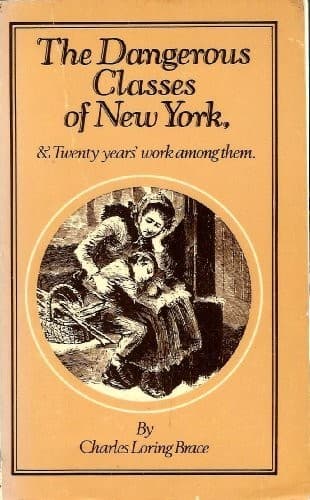
The Dangerous Classes of New York, and Twenty Years' Work Among ThemBrace, Charles Loring
History
The Dangerous Classes of New York, and Twenty Years' Work Among Them
Brace, Charles Loring
Child welfare -- New York (State) -- New York; New York (N.Y.) -- Social conditions; Poor -- New York (State) -- New York
"Now I will only add that the Maestro (teacher) at the Five Points has
become an indispensable personage among them. He is assumed to be a
lawyer, medical doctor, theologian, astronomer, banker--everything as
well as a teacher. A boy is arrested for throwing stones in the street;
the Maestro is applied to and the boy is released. One has fifty dollars
to deposit; the Maestro is consulted as to the soundness of the
savings-banks--and so on. But, to better appreciate their feelings on
this subject, it must be known that these poor foreigners have for a
long while been victimized by the grossest impositions. I have heard of
as much as one thousand dollars lost by one family, through the sharp
practice of a man (an Italian) who, taking advantage of their ignorance
of the English, and of their confidence, deposited and drew in his name
the money which was intended as part payment for a farm they had bought
in Massachusetts, and gave them to understand that the bank had failed.
And this is one of the many cases they had related to me on the subject.
Nor less shameful imposition they suffered at the hands of the
"shysters" whenever some juvenile delinquent was arrested for trifles.
They had to pay from fifty to one hundred dollars, and, what was worse,
often without obtaining their release. In order to explain the process
by which poor people possess such cash amounts, I must say that in
extraordinary circumstances they help each other with the most
disinterested and prompt liberality. Some of those who go to California,
having borrowed the money here, remit it generally in drafts payable to
order of lenders, who, being unknown to the bank, are refused payment.
The Maestro then, of course, is applied to, and for the first two or
three cases I found it hard to make them understand that I did not do it
for money. They would insist on my receiving something for my trouble in
procuring payment by the drawees, and one, especially, on having paid a
draft of one hundred and sixty dollars gold, followed me for a block,
with a coin piece in his hand, insisting that I should take it. 'My dear
man, keep your money,' I would say; 'I am very glad to have been able to
render you this service.' 'No, Maestro, no. Well, take _at least_ these
five dollars' (gold). That _at least_ struck me that he must have been
laboring under the impression that my services were worth considerably
more, and I addressed him in that sense. In answer, he explained that an
Italian, who has gone away from New York, charged him and others ten per
cent, for cashing drafts to order.
Public-domain text, read in full here on John Shaqi.
Reviews
Reviews
No reviews yet
Be the first to share your thoughts on this work.
Elsewhere in the archive
Join the Discussion
Join the discussion
Sign in to leave a comment or review.
Sign InorCreate an account