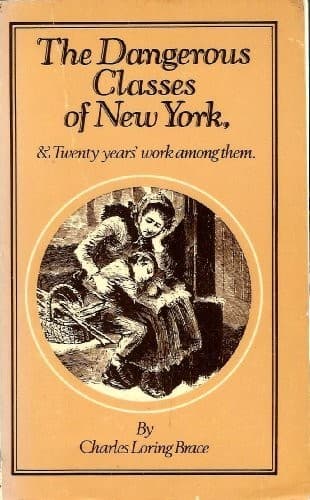
The Dangerous Classes of New York, and Twenty Years' Work Among ThemBrace, Charles Loring
History
The Dangerous Classes of New York, and Twenty Years' Work Among Them
Brace, Charles Loring
Child welfare -- New York (State) -- New York; New York (N.Y.) -- Social conditions; Poor -- New York (State) -- New York
Our plan of visitation among the families of the poor, whereby the
helping hand is held out to juvenile poverty and ignorance all the
while, has been effectually carried out by a very earnest worker, Mr. M.
Dupuy, in the lower wards, and by a young German-American of much
judgment and zeal, Mr. Holste, in the German quarter, and by quite a
number of female visitors.
[Illustration: "PLEASE SIR, MAY I HAVE A BED?" (A sketch from life.) NO.
1.]
CHAPTER XIX.
THE BEST REMEDY FOR JUVENILE PAUPERISM.
"Ameliorer l'homme par le terre et la terre par l'homme." DEMETZ
Among the lowest poor of New York, as we stated in a previous chapter,
the influence of _overcrowding_ has been incredibly debasing. When we
find half a dozen families--as we frequently do--occupying one room, the
old and young, men and women, boys and girls of all ages sleeping near
each other, the result is inevitable. The older persons commit unnatural
crimes; the younger grow up with hardly a sense of personal dignity or
purity; the girls are corrupted even in childhood; and the boys become
naturally thieves, vagrants, and vicious characters. Such apartments are
at once "fever-nests" and seminaries of vice. The inmates are weakened
and diseased physically, and degraded spiritually. Where these houses
abound, as formerly in the Five Points, or now in the First Ward, or
near Corlear's Hook, or in the Seventeenth Ward near the Tenth Avenue,
there is gradually formed a hideous society of vice and pauperism. The
men are idle and drunken, the women lazy, quarrelsome, and given to
begging; the children see nothing but examples of drunkenness, lust, and
idleness, and they grow up inevitably as sharpers, beggars, thieves,
burglars, and prostitutes. Amid such communities of outcasts the
institutions of education and religion are comparatively powerless. What
is done for the children on one sacred day is wiped out by the influence
of the week, and even daily instruction has immense difficulty in
counteracting the lessons of home and parents.
For such children of the outcast poor, a more radical cure is needed
than the usual influences of school and church.
The same obstacle also appeared soon with the homeless lads and girls
who were taken into the Lodging-houses. Though without a home, they were
often not legally vagrant--that is, they had some ostensible occupation,
some street-trade--and no judge would commit them, unless a very
flagrant case of vagrancy was made out against them. They were unwilling
to be sent to Asylums, and, indeed, were so numerous that all the
Asylums of the State could not contain them. Moreover, their care and
charge in public institutions would have entailed expenses on the city
so heavy, that tax-payers would not have consented to the burden.
Public-domain text, read in full here on John Shaqi.
Reviews
Reviews
No reviews yet
Be the first to share your thoughts on this work.
Elsewhere in the archive
Join the Discussion
Join the discussion
Sign in to leave a comment or review.
Sign InorCreate an account