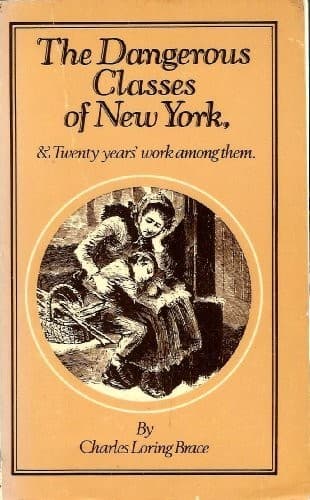
The Dangerous Classes of New York, and Twenty Years' Work Among ThemBrace, Charles Loring
History
The Dangerous Classes of New York, and Twenty Years' Work Among Them
Brace, Charles Loring
Child welfare -- New York (State) -- New York; New York (N.Y.) -- Social conditions; Poor -- New York (State) -- New York
Among other objections, it was feared that the farmers would not want
the children for help; that, if they took them, the latter would be
liable to ill-treatment, or, if well treated, would corrupt the virtuous
children around them, and thus New York would be scattering seeds of
vice and corruption all over the land. Accidents might occur to the
unhappy little ones thus sent, bringing odium on the benevolent persons
who were dispatching them to the country. How were places to be found?
How were the demand and supply for children's labor to be connected? How
were the right employers to be selected? And, when the children were
placed, how were their interests to be watched over, and acts of
oppression or hard dealing prevented or punished? Were they to be
indentured, or not? If this was the right scheme, why had it not been
tried long ago in our cities or in England?
These and innumerable similar difficulties and objections were offered
to this projected plan of relieving the city of its youthful pauperism
and suffering. They all fell to the ground before the confident efforts
to carry out a well-laid scheme; and practical experience has justified
none of them.
To awaken the demand for these children, circulars were sent out through
the city weeklies and the rural papers to the country districts.
Hundreds of applications poured in at once from the farmers and
mechanics all through the Union. At first, we made the effort to meet
individual applications by sending just the kind of children wanted; but
this soon became impracticable.
Each applicant or employer always called for "a perfect child," without
any of the taints of earthly depravity. The girls must be pretty,
good-tempered, not given to purloining sweetmeats, and fond of making
fires at daylight, and with a constitutional love for Sunday Schools and
Bible-lessons. The boys must be well made, of good stock, never disposed
to steal apples or pelt cattle, using language of perfect propriety, and
delighting in family-worship and prayer-meetings more than in fishing or
skating parties. These demands, of course, were not always successfully
complied with. Moreover, to those who desired the children of "blue
eyes, fair hair, and blond complexion," we were sure to send the
dark-eyed and brunette; and the particular virtues wished for were very
often precisely those that the child was deficient in. It was evidently
altogether too much of a lottery for bereaved parents or benevolent
employers to receive children in that way.
Yet, even under this incomplete plan, there were many cases like the
following, which we extract from our Journal:--
A WAIF.
Public-domain text, read in full here on John Shaqi.
Reviews
Reviews
No reviews yet
Be the first to share your thoughts on this work.
Elsewhere in the archive
Join the Discussion
Join the discussion
Sign in to leave a comment or review.
Sign InorCreate an account