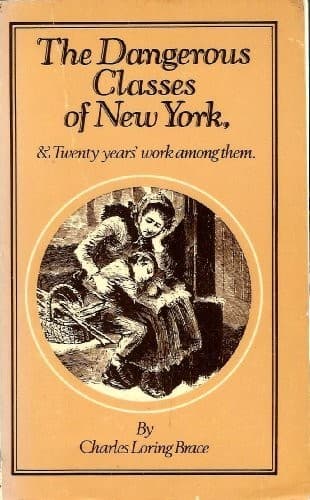
The Dangerous Classes of New York, and Twenty Years' Work Among ThemBrace, Charles Loring
History
The Dangerous Classes of New York, and Twenty Years' Work Among Them
Brace, Charles Loring
Child welfare -- New York (State) -- New York; New York (N.Y.) -- Social conditions; Poor -- New York (State) -- New York
Mr. T. testified before the Senate Committee in 1871, that he had
transplanted to the West some four or five thousand children, and, to
the best of his knowledge and belief, very few ever turned out bad.
Whenever any of these children chanced to be defective in mind or body,
or, from any other cause, became chargeable on the rural authorities, we
made ourselves responsible for their support, during any reasonable time
after their settlement in the West.
Our present agents, Mr. E. Trott and Mr. J. P. Brace, are exceedingly
able and judicious agents, so that we transported, in 1871, to the
country, some three thousand children, at an expense, including all
salaries and costs, of $31,638.
We have also a resident Western agent, Mr. C. R. Fry, who looks after
the interests of those previously sent and prepares for future parties,
traveling from village to village. The duties of all these agents are
very severe and onerous.
It is a matter of devout thankfulness that no accident has ever happened
to any one of the many parties of children we have sent out, or to the
agents.
The following testimony was given by Mr. J. Macy, Assistant Secretary of
the Children's Aid Society, before the Senate Committee, in 1871:--
"Mr. J. Macy testified that he corresponds annually with from eight
thousand to ten thousand persons, and, on an average, receives about two
thousand letters from children and their employers. He has personal
knowledge of a great many boys growing up to be respectable citizens,
others having married well, others graduating in Western colleges. Out
of twenty-one thousand, not over twelve children have turned out
criminals, The percentage of boys returning to the city from the West is
too small to be computed, not more than six annually. From
correspondence and personal knowledge, he is thoroughly satisfied that
but very few turned out bad, and that the only way of saving large boys
from falling into criminal practices is to send them into good
country-homes. He regarded the system of sending families to the West as
one of the best features of the work of the Society. Not a family has
been sent West which has not improved by the removal. The Society had
never changed the name of a child, and Catholic children had often been
intrusted to Catholic families." * * * * *
"Letter from a newsboy to the Superintendent of the Lodging-house:--
"M----, IND., Nov. 24, 1859.
"'TO MY FRIEND AND BENEFACTOR.--So I take my pen in my hand to let you
know how I am, and how I am getting along; As far as I see, I am well
satisfied with my place; but I took a general look around, and, as far
as I see, all the boys left in M---- are doing well, especially myself,
and I think there is as much fun as in New York, for nuts and apples are
all free. I am much obliged to you, Mr. O'Connor, for the paper you sent
me. I received it last night; I read it last night--something about the
Newsboys' Lodging-house.
Public-domain text, read in full here on John Shaqi.
Reviews
Reviews
No reviews yet
Be the first to share your thoughts on this work.
Elsewhere in the archive
Join the Discussion
Join the discussion
Sign in to leave a comment or review.
Sign InorCreate an account