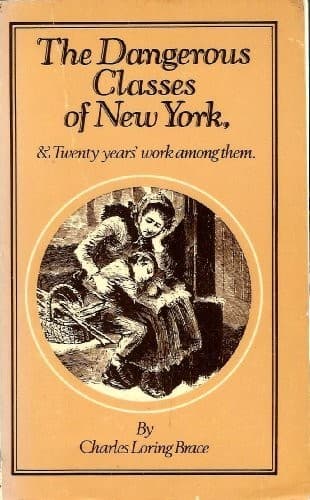
The Dangerous Classes of New York, and Twenty Years' Work Among ThemBrace, Charles Loring
History
The Dangerous Classes of New York, and Twenty Years' Work Among Them
Brace, Charles Loring
Child welfare -- New York (State) -- New York; New York (N.Y.) -- Social conditions; Poor -- New York (State) -- New York
This has become a kind of eddying-point, where the two streams of the
fortunate and the unfortunate classes seem to meet. Such a varying
procession of humanity as passes through these plain rooms, from one
year's end to the other, can nowhere else be seen. If photographs could
be taken of the human life revealed there, they would form a volume of
pictures of the various fortunes of large classes in a great city. On
one day, there will be several mothers with babes. They wish them
adopted, or taken by any one. They relate sad stories of desertion and
poverty; they are strangers or immigrants. When the request is declined,
they beseech, and say that the child must die, for they cannot support
both. It is but too plain that, they are illegitimate children; As they
depart, the horrible feeling presses on one, that the child will soon
follow the fate of so many thousands born out of wedlock. Again, a
pretty young woman comes to beg a home for the child of some friend, who
cannot support it. Her story need not be told; the child is hers, and is
the offspring of shame. Or some person from the higher classes enters,
to inquire for the traces of some boy, long disappeared--the child of
passion and sin.
But the ordinary frequenters are the children of the street--the Arabs
and gypsies of our city.
Here enters a little flower-seller, her shawl drawn over her head,
barefooted and ragged--she begs for a home and bread; here a newsboy,
wide-awake and impudent, but softened by his desire to "get West;" here
"a bummer," ragged, frouzy, with tangled hair and dirty face, who has
slept for years in boxes and privies; here a "canawl-boy," who cannot
steer his little craft in the city as well as he could his boat; or a
petty thief who wishes to reform his ways, or a bootblack who has
conceived the ambition of owning land, or a little "revolver" who hopes
to get quarters for nothing in a Lodging-house and "pitch pennies" in
the interval. Sometimes some yellow-haired German boy, stranded by
fortune in the city, will apply, with such honest blue eyes, that the
first employer that enters will carry him off; or a sharp, intelligent
Yankee lad, left adrift by sudden misfortune, comes in to do what he has
never done before--ask for assistance. Then an orphan-girl will appear,
floating on the waves of the city, having come here no one knows why,
and going no one can tell whither.
Employers call to obtain "perfect children;" drunken mothers rush in to
bring back their children they have already consented should be sent far
from poverty and temptation; ladies enter to find the best object of
their charities, and the proper field for their benevolent labors;
liberal donors; "intelligent foreigners," inquiring into our
institutions, applicants for teachers' places, agents, and all the
miscellaneous crowd who support and visit agencies of charity.
A PRACTICAL PHILANTHROPIST.
Public-domain text, read in full here on John Shaqi.
Reviews
Reviews
No reviews yet
Be the first to share your thoughts on this work.
Elsewhere in the archive
Join the Discussion
Join the discussion
Sign in to leave a comment or review.
Sign InorCreate an account