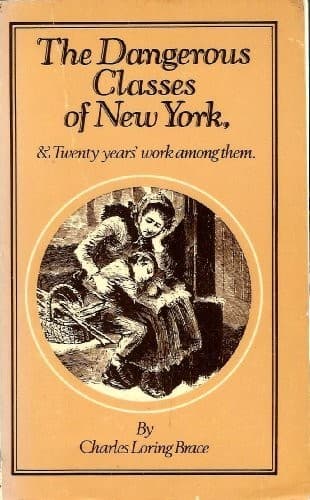
The Dangerous Classes of New York, and Twenty Years' Work Among ThemBrace, Charles Loring
History
The Dangerous Classes of New York, and Twenty Years' Work Among Them
Brace, Charles Loring
Child welfare -- New York (State) -- New York; New York (N.Y.) -- Social conditions; Poor -- New York (State) -- New York
As a result of this incessant publicity, and of the work already done, a
very superior class of young men consented to serve in our Board of
Trustees; men who, in their high principles of duty, and in the
obligations which they feel are imposed by wealth and position, bid fair
hereafter to make the name of New York merchants respected as it never
was before throughout the country. With these as backers and
supervisors, we were enabled to approach the Legislature for aid, on the
ground that we were doing a humane work which lightened the taxes and
burdens of the whole community and was in the interest of all. Year
after year our application was rejected, but finally we succeeded, and
laid a solid and permanent basis thus for our future work.
SOURCES OF INCOME.
Our first important acquisition of property was a bequest from a
much-esteemed pupil of mine, J. B. Barnard, of New Haven, Conn., of
$15,000, in 1856. We determined to use this at once in the work. For
many years, finding the needs of the city so enormous, and believing
that our best capital was in the results of our efforts, and not in
funds, we spent every dollar we could obtain at once upon our labors of
charity.
At length, in 1863, a very fortunate event occurred for us: a gentleman
had died in New York, named John Rose, who left a large property which
he willed should be appropriated to forming some charitable institution
for neglected children, and, under certain conditions, to the
Colonization Society. The will was so vaguely worded, that the brother,
Mr. Chauncey Rose, felt it necessary to attempt to break it. This, after
long litigation, he succeeded in doing, and the property--now swollen to
the amount of nearly a million dollars--reverted mainly to him. With a
rare conscience and generosity, he felt it his duty not to use any of
this large estate for himself, but to distribute it among various
charities in New York, relating to poor children, according to what
appeared to be the intention of his brother. To our Society he gave, at
different times, something like $200,000. Of this, we made $150,000 an
invested fund; and henceforth we sought gradually to increase our
permanent and assured income, so that the Association might continue its
benevolent work after the present managers had departed.
And yet we were glad that a good proportion of our necessary expenses
should be met by current contributions, so that the Society might have
the vitality arising from constant contact with the public, as well as
the permanency from invested property.
Public-domain text, read in full here on John Shaqi.
Reviews
Reviews
No reviews yet
Be the first to share your thoughts on this work.
Elsewhere in the archive
Join the Discussion
Join the discussion
Sign in to leave a comment or review.
Sign InorCreate an account