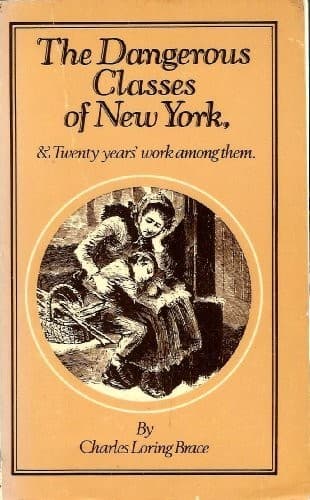
The Dangerous Classes of New York, and Twenty Years' Work Among ThemBrace, Charles Loring
History
The Dangerous Classes of New York, and Twenty Years' Work Among Them
Brace, Charles Loring
Child welfare -- New York (State) -- New York; New York (N.Y.) -- Social conditions; Poor -- New York (State) -- New York
The rooms were spacious and pleasant, furnished with a plenty of papers
and pamphlets, and, to add to the attractions and help pay expenses, the
superintendent was to sell coffee and simple refreshments. Our theory
was, that coffee would compete with liquor as a stimulus, and that the
profits of the sale would pay most of the running cost. We were right
among a crowded working population, and everything promised success.
At first there were considerable numbers of laboring-men present every
day and evening; but, to our dismay, they began to fall off. We tried
another superintendent; still the working-man preferred his "dreary
rooms," or the ruinous liquor-shops, to our pleasant Reading-room. The
coffee did not suit him; the refreshments were not to his taste; he
would not read, because he thought he ought to call for something to eat
or drink if he did; and so at length he dropped off. Finally, the
attendance became so thin and the expenses were accumulating to such a
degree, that we closed the room, and our magnanimous treasurer footed
the bills. This failure discouraged us for some years, but the idea
seemed to me sound, and I was resolved to try it once more under better
circumstances.
In looking about for some specially-adapted instrument for influencing
"the dangerous classes," I chanced, just after the remarkable religious
"Revival of 1858" on a singular character,
A REFORMED PUGILIST.
This was a reformed or converted prize-fighter, named Orville (and
nicknamed "Awful") Gardner. He was a broad-shouldered, burly individual,
with a tremendous neck, and an arm as thick as a moderate-sized man's
leg. His career had been notorious and infamous in the extreme, he
having been one of the roughs employed by politicians, and engaged in
rows and fights without number, figuring several times in the
prize-ring, and once having bitten off a man's nose!
Yet the man must have been less brutal than his life would show. He was
a person evidently of volcanic emotions and great capacity of affection.
I was curious about his case, and watched it closely for some years, as
showing what is so often disputed in modern times--the reforming power
of Christianity on the most abandoned characters.
The point through which his brutalized nature had been touched, had been
evidently his affection for an only child--a little boy. He described to
me once, in very simple, touching language, his affection and love for
this child; how he dressed him in the best, and did all he could for
him, but always keeping him away from all knowledge of his own
dissipation. One day he was off on some devilish errand among the
immigrants on Staten Island, when he saw a boat approaching quickly with
one of his "pals." The man rowed up near him, and stopped and looked at
him "very queer," and didn't say anything.
"What the devil are you looking at me in that way for?" said Gardner.
"Your boy is drownded!" replied the other.
Public-domain text, read in full here on John Shaqi.
Reviews
Reviews
No reviews yet
Be the first to share your thoughts on this work.
Elsewhere in the archive
Join the Discussion
Join the discussion
Sign in to leave a comment or review.
Sign InorCreate an account