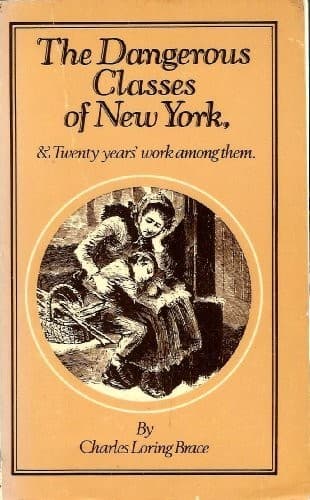
The Dangerous Classes of New York, and Twenty Years' Work Among ThemBrace, Charles Loring
History
The Dangerous Classes of New York, and Twenty Years' Work Among Them
Brace, Charles Loring
Child welfare -- New York (State) -- New York; New York (N.Y.) -- Social conditions; Poor -- New York (State) -- New York
Seventeen years ago, my attention had been called to the extraordinarily
degraded condition of the children in a district lying on the west side
of the city, between Seventeenth and Nineteenth Streets, and the Seventh
and Tenth Avenues. A certain block, called "Misery Row," in Tenth
Avenue, was the main seedbed of crime and poverty in the quarter, and
was also invariably a "fever-nest." Here the poor obtained wretched
rooms at a comparatively low rent; these they sub-let, and thus, in
little, crowded, close tenements, were herded men, women, and children
of all ages. The parents were invariably given to hard drinking, and the
children were sent out to beg or to steal. Besides them, other children,
who were orphans, or who had run away from drunkards' homes, or had been
working on the canal-boats that discharged on the docks near by, drifted
into the quarter, as if attracted by the atmosphere of crime and
laziness that prevailed in the neighborhood. These slept around the
breweries of the ward, or on the hay-barges, or in the old sheds of
Eighteenth and Nineteenth Streets. They were mere children, and kept
life together by all sorts of street-jobs--helping the brewery laborers,
blackening boots, sweeping sidewalks, "smashing baggages" (as they
called it), and the like. Herding together, they soon began to form an
unconscious society for vagrancy and idleness. Finding that work brought
but poor pay, they tried shorter roads to getting money by petty thefts,
in which they were very adroit. Even if they earned a considerable sum
by a lucky day's job, they quickly spent it in gambling, or for some
folly.
The police soon knew them as "street-rats;" but, like the rats, they
were too quick and cunning to be often caught in their petty
plunderings, so they gnawed away at the foundations of society
undisturbed. As to the "popular education" of which we boast, and the
elevating and inspiring faith of Christianity which had reared its
temples all around them, they might almost as well have been the
children of the Makololos in Central Africa. They had never been in
school or church, and knew of God and Christ only in street-oaths, or as
something of which people far above them spoke sometimes.
I determined to inaugurate here a regular series of the "moral
disinfectants," if I may so call them, for this "crime-nest," which act
almost as surely, though not as rapidly, as do the physical
disinfectants--the sulphate of iron, the chloride of lime, and the
various deodorizers of the Board of Health--in breaking up the
"fever-nests" of the city.
These measures, though imitated in some respects from England, were
novel in their combination.
Public-domain text, read in full here on John Shaqi.
Reviews
Reviews
No reviews yet
Be the first to share your thoughts on this work.
Elsewhere in the archive
Join the Discussion
Join the discussion
Sign in to leave a comment or review.
Sign InorCreate an account