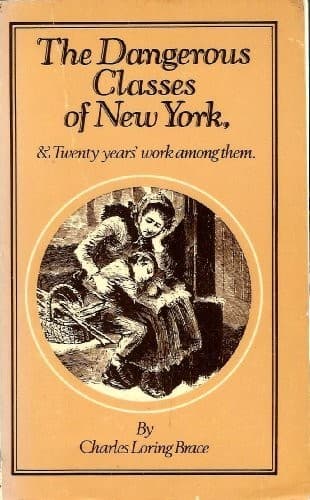
The Dangerous Classes of New York, and Twenty Years' Work Among ThemBrace, Charles Loring
History
The Dangerous Classes of New York, and Twenty Years' Work Among Them
Brace, Charles Loring
Child welfare -- New York (State) -- New York; New York (N.Y.) -- Social conditions; Poor -- New York (State) -- New York
"Yesterday, Mr. Slater brought a thin, sad boy to us--had found him in
the streets and heard his story, and then gave him a breakfast, and led
him up to our office. The lad seemed like one weary almost of living.
'Where are your father and mother, my boy?' 'Both dead, sir.' 'Where are
your other relatives or friends?' 'Hain't got no friends, sir; I've
lived by myself on the street.' 'Where did you stay?' 'I slept _in the
privy_ sometime, sir; and then in the stables in Sixteenth Street.'
'Poor fellow,' said some one, 'how did you get your living?' 'Begged
it--and then, them stable-men, they give me bread sometimes.' 'Have you
ever been to school, or Sunday School?' 'No, sir.' So the sad story went
on. Within two blocks of our richest houses, a desolate boy grows up,
not merely out of Christianity and out of education, but out of a common
human shelter, and of means of livelihood.
"The vermin were creeping over him as he spoke. A few days before this,
Mr. S. had brought up three thorough-going street-boys--active, bold,
impudent, smart fellows--a great deal more wicked and much less
miserable than this poor fellow. Those three were sent to Ohio together,
and this last boy, after a thorough washing and cleansing, was to be
dispatched to Illinois. A later note adds: 'The lad was taken by an old
gentleman of property, who, being childless, has since adopted the boy
as his own, and will make him heir to a property.'"
Several other lads were helped to an honest livelihood. A Visitor was
then appointed, who lived and worked in the quarter. But our moral
treatment for this nest of crime had only commenced.
We appealed to the public for aid to establish the reforming agencies
which alone can cure these evils, and whose foundation depends mainly on
the liberality, in money, of our citizens. We warned them that these
children, if not instructed, would inevitably grow up as ruffians. We
said often that they would not be like the stupid foreign criminal
class, but that their crimes, when they came to maturity, would show the
recklessness, daring, and intensity of the American character. In our
very first report (for 1854) we said:--
Public-domain text, read in full here on John Shaqi.
Reviews
Reviews
No reviews yet
Be the first to share your thoughts on this work.
Elsewhere in the archive
Join the Discussion
Join the discussion
Sign in to leave a comment or review.
Sign InorCreate an account