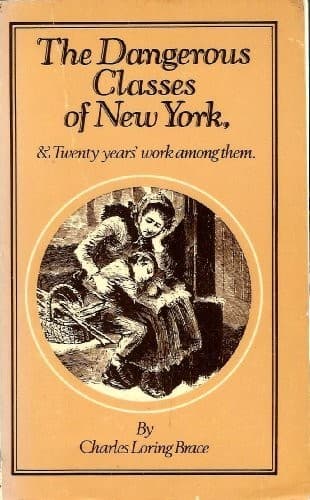
The Dangerous Classes of New York, and Twenty Years' Work Among ThemBrace, Charles Loring
History
The Dangerous Classes of New York, and Twenty Years' Work Among Them
Brace, Charles Loring
Child welfare -- New York (State) -- New York; New York (N.Y.) -- Social conditions; Poor -- New York (State) -- New York
If any of my readers should ever be inclined to investigate a very
miserable quarter of the city, let them go down to our "Corlear's Hook,"
so infamous twenty years ago for murders and terrible crimes, and then
wind about among the lanes and narrow streets of the district. Here they
will find every available inch of the ground made use of for residences,
so that each lot has that poisonous arrangement, a "double house,"
whereby the air is more effectually vitiated, and a greater number of
human beings are crowded together. From this massing-together of
families, and the drunken habits prevailing, it results very naturally
that the children prefer outdoor life to their wretched tenements, and,
in the milder months, boys and girls live a _dolce far niente_ life on
the docks and wood-piles, enjoying the sun and the swimming, and picking
up a livelihood by petty thieving and peddling.
Sometimes they all huddle together in some cellar, boys and girls, and
there sleep. In winter they creep back to the tenement-houses, or hire a
bed in the vile lodgings which are found in the Ward. They grow up,
naturally, the wildest little "Topseys" and "Gavroches" that can be
found. Ragged, impudent, sharp, able "to paddle their canoe" through all
the rapids of the great city--the most volatile and uncertain of
children; today in school, to-morrow miles away; many of them the most
skillful of petty thieves, and all growing up to prey on the city.
In the midst of this quarter we found an old Public School building--a
dilapidated old shell--which we hired and refitted. It had the especial
advantage of being open to air and light on four sides. We soon
transformed it into one of the most complete and attractive little
agencies of instruction and charity which ever arose in the dark places
of a crowded metropolis. We struck upon a superintendent--Mr. G.
Calder--who, with other good qualities, had the artistic gift--who, by a
few flowers, or leaves, or old engravings, could make any room look
pleasing. He exerted his talent in embellishing this building, and in
making a cheerful spot in the midst of a ward filled with rookeries and
broken-down tenements. In the bit of a back yard he created a beautiful
garden, with shrubbery and flowers, with vases and a cool shaded
seat--and these in a place of the size of a respectable closet. There a
poor child could stand and fancy herself, for a moment, far away in the
country, Thence, on a spring morning, drowning the prevalent smells of
bilge-water and sewers, ascended the sweet odors of hyacinth and
heliotrope, sweet-william and violet. Above, in the school-rooms and the
lodging-rooms, these sweet flowers were scattered about, taming and
refining, for the time, the rough little subjects who frequented them.
Soon a novel reward was proposed, and the best children in the School
were allowed to take a plant home with them, and, if they brought it
back improved in a few months, to receive others as a premium; so that
Public-domain text, read in full here on John Shaqi.
Reviews
Reviews
No reviews yet
Be the first to share your thoughts on this work.
Elsewhere in the archive
Join the Discussion
Join the discussion
Sign in to leave a comment or review.
Sign InorCreate an account