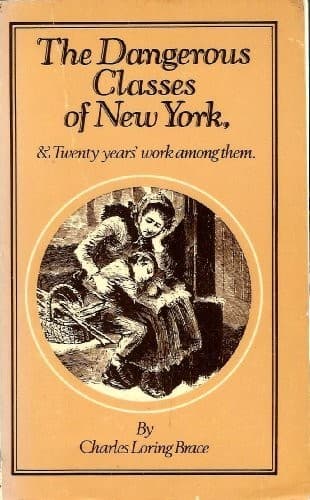
The Dangerous Classes of New York, and Twenty Years' Work Among ThemBrace, Charles Loring
History
The Dangerous Classes of New York, and Twenty Years' Work Among Them
Brace, Charles Loring
Child welfare -- New York (State) -- New York; New York (N.Y.) -- Social conditions; Poor -- New York (State) -- New York
We respect the sort of pluck of the Protestants, which looks upon the
giving-up of Bible-reading in the Schools as being "false to the flag."
But, in looking at the matter soberly, and without pugnacity, does
spiritual religion lose anything by giving up these exercises? We think
not. They are now of the coldest and most formal kind, and but little
listened to. We doubt if they ever affect strongly a single mind. The
religious education of each child is imparted in Sabbath Schools, in
Churches, or Mission Schools, and its own home.
The Free School under our system does not need any influence from the
Church. The American trusts to the separate sects to take care of the
religious interests of the children. We separate utterly Church and
State. There may be evils from this; but they are less than the danger
of destroying our system of popular education by the contests of rival
sects. We know how long every effort to secure popular education for
England has been wrecked on this rock of Sectarianism.
We behold the fearful harvest of evils which she is reaping from the
ignorance of the masses, especially induced by the oppositions of sects,
who preferred no education for the people to education without their own
dogmas.
We desire to avoid these calamities, and we can best do this by making
every reasonable concession to ignorance and prejudice.
Give us the Free Schools without Religion, rather than no Free Schools
at all!
CHAPTER XXXVI.
DECREASE OF JUVENILE CRIME IN NEW YORK.
THE COST OF PUNISHMENT AND PREVENTION.
Very few people have any just appreciation of the comparative cost of
punishment and prevention in the treatment of crime. The writer recalls
one out of many thousand instances in his experience, which strikingly
illustrates the contrast
THE BROTHERS.
A number of years ago, three boys (brothers), the oldest perhaps
seventeen, applied at the Newsboys' Lodging-house of this city for
shelter. It was soon suspected that the eldest was a thief, employing
the younger as assistants in his nefarious business. The younger lads
finally confessed the fact, and the older brother left them to be taken
care of in the Lodging-house. After a sufficient period of training, the
two brothers were sent to a farmer in Illinois. They were faithful and
hard-working, and soon began to earn money. When the war broke out they
enlisted, and served with credit. At the close they passed through New
York, and visited the superintendent while returning to their village,
having already purchased a farm with their wages and bounty-money. They
are now well-to-do, respectable farmers.
This "prevention" for the two lads cost just thirty dollars, for their
expenses in the Lodging-house were mainly paid by themselves.
Public-domain text, read in full here on John Shaqi.
Reviews
Reviews
No reviews yet
Be the first to share your thoughts on this work.
Elsewhere in the archive
Join the Discussion
Join the discussion
Sign in to leave a comment or review.
Sign InorCreate an account