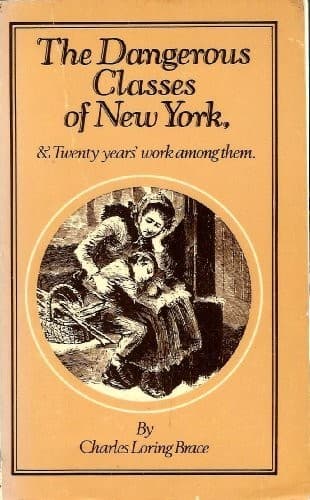
The Dangerous Classes of New York, and Twenty Years' Work Among ThemBrace, Charles Loring
History
The Dangerous Classes of New York, and Twenty Years' Work Among Them
Brace, Charles Loring
Child welfare -- New York (State) -- New York; New York (N.Y.) -- Social conditions; Poor -- New York (State) -- New York
Two or three men of their position, wealth, and ability, who should take
the moral interests of any class of our population on their hands, and
be in earnest in the thing, could not fail to accomplish great results.
When they began to appear in our Board, I felt that, under any sort of
judicious management, it was morally certain we should perfect a wide
and permanent organization, and secure most encouraging results.
A great service, which has been accomplished by these gentlemen, has
been in tabulating our accounts, and putting them under a most thorough
system of examination and checking, and in allotting our various
branches to each trustee for inspection. Many of the trustees, also,
have their religious meetings at the Lodging-houses, which they
individually lead and take charge of during the winter. They are thus
brought in direct contact with the necessities of the poor children.
To no one, however, is the public so much indebted as to our treasurer,
Mr. J. E. Williams.
For nearly twenty years this charity has been the dearest object of his
public efforts, the field of his humanity and religion. During all this
time he has managed gratuitously the financial affairs of the Society;
begged money when we were straitened, and borrowed it when temporarily
embarrassed; never for a moment doubting that, if the work were
faithfully done, the public would support it. At the end of this period
(1872), having spent over a million of dollars, and requiring now some
one hundred and seventy-five thousand dollars per annum for our various
branches, we find ourselves without a dollar of debt.
THE SECTARIAN DANGER.
One rock, which the manager of such a movement must always steer clear
of, is the sectarian difficulty. He must ignore sects, and rest his
enterprise on the broadest and simplest principles of morality and
religion. The animating force must be the religious, especially the
"enthusiasm of humanity" shown in the love for Christ, and for all who
bear His image. But dogmatic teachings, and disputations, and sectarian
ambitions, are to be carefully eschewed and avoided in such efforts of
humanity. The public must learn gradually to associate the movement, not
with any particular sect or church, but with the feeling of humanity and
religion--the very spirit of Christ Himself.
An essential thing, and often very disagreeable, to the earnest worker
in it, is to give the utmost publicity to all its operations. The reason
of this is, that such a charity depends for support and friends, not on
an organized private association, but on the whole public. They need to
know all its doings; this is often the only way of reminding them of
their duty in this field. Moreover, the moneys spent are public trusts,
and all that relates to their uses should be publicly known.
Public-domain text, read in full here on John Shaqi.
Reviews
Reviews
No reviews yet
Be the first to share your thoughts on this work.
Elsewhere in the archive
Join the Discussion
Join the discussion
Sign in to leave a comment or review.
Sign InorCreate an account