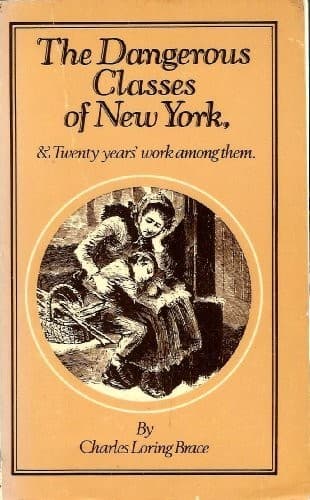
The Dangerous Classes of New York, and Twenty Years' Work Among ThemBrace, Charles Loring
History
The Dangerous Classes of New York, and Twenty Years' Work Among Them
Brace, Charles Loring
Child welfare -- New York (State) -- New York; New York (N.Y.) -- Social conditions; Poor -- New York (State) -- New York
It has become remarkably apparent, during the last few years, that one
of the best modes of driving out low tastes in the masses is to
introduce higher. It has been found that galleries and museums and parks
are the most formidable rivals of the liquor-shops. The experience near
the Sydenham Palace, in England, and other places of instructive and
pleasant resort for the laboring masses, is, that drinking-saloons do
not flourish in opposition. Wherever, in the evening, a laboring-man can
saunter in a pleasant park, or, in company with his wife and family,
look at interesting pictures, or sculpture, or objects of curiosity, he
has not such a craving for alcoholic stimulus.
Even open-air drinking in a garden--as is so common on the Continent--is
never so excessive as in an artificial-lighted room. Where, too, a
working-man can, in a few steps, find a cheerfully-lighted reading-room,
with society or papers, or where a club is easily open to him without
drinking, it will also be found that he ceases to frequent the saloon,
and almost loses his taste for strong drink.
Whatever elevates the taste of the laborer, or expands his mind, or
innocently amuses him, or passes his time pleasantly without indulgence,
or agreeably instructs, or provides him with virtuous associations,
tends at once to guard him from habits of intoxication. The Kensington
Museum and Sydenham Palace, of London; the Cooper Union, the Central
Park, and free Reading-rooms of New York, are all temperance-societies
of the best kind. The great effort now is to bring this class of
influences to bear on the habits of the laboring-people, and thus
diminish intemperance.
It is a remarkable fact, in this connection, that, though ninety out of
the hundred of our children in the Industrial Schools are the children
of drunkards, not one of the thousands who have gone forth from them has
been known to have fallen into intemperate habits. Under the elevating
influences of the school, they imperceptibly grow out of the habits of
their mothers and fathers, and never acquire the appetite.
Another matter, which is well worthy of the attention of reformers, is
the possibility of introducing into those countries where "heavy
drinking" prevails, the taste for light wines and the habit of open-air
drinking. The passion for alcohol is a real one. On a broad scale it
cannot be annihilated. Can we not satisfy it innocently? In this
country, for instance, light wines can be made to a vast extent, and
finally be sold very cheaply. If the taste for them were formed, would
it not expel the appetite for whisky and brandy, or at least, in the
coming generation, form a new habit?
Public-domain text, read in full here on John Shaqi.
Reviews
Reviews
No reviews yet
Be the first to share your thoughts on this work.
Join the Discussion
Join the discussion
Sign in to leave a comment or review.
Sign InorCreate an account