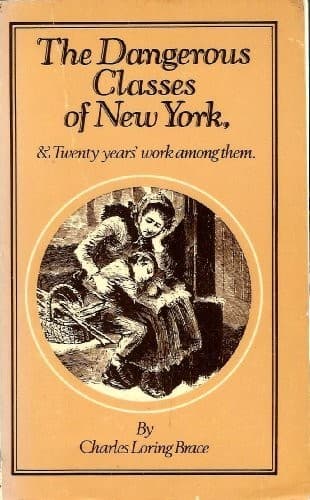
The Dangerous Classes of New York, and Twenty Years' Work Among ThemBrace, Charles Loring
History
The Dangerous Classes of New York, and Twenty Years' Work Among Them
Brace, Charles Loring
Child welfare -- New York (State) -- New York; New York (N.Y.) -- Social conditions; Poor -- New York (State) -- New York
But it was always apparent to the writer that, with the peculiar
constitution of the population of this city, it could not be sustained,
unless concessions were made to the prejudices and habits of certain
nationalities among our citizens. Our reformers, however, as a class,
are exceedingly adverse to concessions; they look at questions of habits
as absolute questions of right and wrong, and they will permit no
half-way or medium ground. But legislation is always a matter of
concession. We cannot make laws for human nature as it ought to be, but
as it is. If we do not get the absolutely best law passed, we must
content ourselves with the medium best. If our Temperance Reformers had
permitted a clause in the law, excepting the drinking in gardens, or of
lager-beer, from the restrictions of the License Law, we should not,
indeed, have had so good a state of things as we had for a few years,
under the old law, but we might have had it permanently. Now, we have
nearly lost all control over drinking, and the Sunday orgies and crimes
will apparently renew themselves without check or restraint. If a reform
in legislation claim too much, there is always a severe reaction
possible, when the final effects will be worse than the evils sought to
be corrected.
The true plan of reform for this city would be to cause the License Law
of 1866 to be re-enacted with certain amendments. The "intoxicating
drinks" mentioned should be held not to include lager-beer or certain
light wines; and garden-drinking might be permitted, under strict police
surveillance.
The Excise Board should be allowed very summary control, however, even
over the German gardens and lager-beer drinking-places, so that, if they
were perverted into places of disturbance and intoxication, the licenses
could be revoked.
[Illustration: THE FORTUNES OF A STREET WAIF. (Fourth Stage.)]
By separating absolutely the licenses for light drinks and those for
rum, whisky, and heavy ales, a vast deal of drunkenness might be
prevented, and yet the foreign habits not be too much interfered with,
and comparatively innocent pleasures permitted. In small towns and
villages, a reasonable compromise would seem to be to allow each
municipality to control the matter in the mode it preferred: some
communities in this way, forbidding all sale of intoxicating liquors,
and others permitting it, under conditions; but each being responsible
for the evils or benefits of the system it adopted.
Public-domain text, read in full here on John Shaqi.
Reviews
Reviews
No reviews yet
Be the first to share your thoughts on this work.
Join the Discussion
Join the discussion
Sign in to leave a comment or review.
Sign InorCreate an account