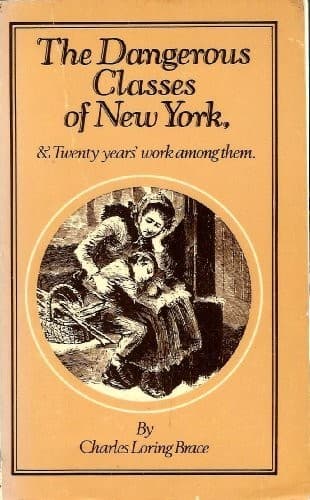
The Dangerous Classes of New York, and Twenty Years' Work Among ThemBrace, Charles Loring
History
The Dangerous Classes of New York, and Twenty Years' Work Among Them
Brace, Charles Loring
Child welfare -- New York (State) -- New York; New York (N.Y.) -- Social conditions; Poor -- New York (State) -- New York
Then, again, in religious communities, such as the English and American,
there is too great a confidence in _technical religious_ means.
We would not breathe a word against the absolute necessity of
Christianity in any scheme of thorough social reform. If the Christian
Church has one garland on its altars which time does not wither nor
skepticism destroy, which is fresh and beautiful each year, it is that
humble offering laid there through every age by the neglected little
ones of society, whom the most enlightened Stoicism despised and
Paganism cast out, but who have been blessed and saved by its
ministrations of love. No skeptical doubt or "rationalism" can ever
pluck from the Christian Church this, its purest crown.
To attempt to prevent or cure the fearful moral diseases of our lowest
classes without Christianity, is like trying to carry through a sanitary
reform in a city without sunlight.
But the mistake we refer to, is a too great use of, or confidence in,
the old technical methods--such as distributing tracts, and holding
prayer-meetings, and, scattering Bibles. The neglected and ruffian class
which we are considering are in no way affected directly by such
influences as these. New methods must be invented for them.
Another obstacle, in American cities, to any comprehensive results of
reform or prevention among these classes, has been the too blind
following of European precedents. In Europe, the labor-market is fully
supplied. There is a steady pressure of population on subsistence. No
general method of prevention or charity can be attempted which
interferes with the rights of honest and self-supporting labor. The
victims of society, the unfortunate, the _enfants perdus,_ must be
retained, when aided at all, in public institutions. They cannot be
allowed to compete with outside industry. They are not wanted in the
general market of labor. They must be kept in _Asylums._
Now, Asylums are a bequest of monastic days. They breed a species of
character which is monastic-indolent, unused to struggle; subordinate
indeed, but with little independence and manly vigor. If the subjects of
the modern monastery be unfortunates--especially if they be already
somewhat tainted with vice and crime--the effect is a weakening of true
masculine vigor, an increase of the apparent virtues, and a hidden
growth of secret and contagious vices. Moreover, the life under the
machinery of an "Institution" does not prepare for the thousand petty
hand-labors of a poor man's cottage. But, greatest of all objections,
the asylum system is, of necessity, immensely expensive, and can reach
but a comparatively small number of subjects.
These various obstacles and difficulties, which impede thorough work for
the elevation of our worst classes, can, however, be overcome.
PIONEER WORK.
Public-domain text, read in full here on John Shaqi.
Reviews
Reviews
No reviews yet
Be the first to share your thoughts on this work.
Join the Discussion
Join the discussion
Sign in to leave a comment or review.
Sign InorCreate an account