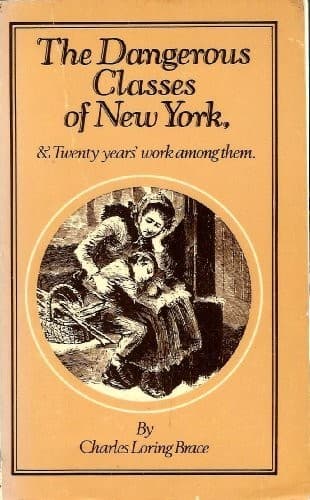
The Dangerous Classes of New York, and Twenty Years' Work Among ThemBrace, Charles Loring
History
The Dangerous Classes of New York, and Twenty Years' Work Among Them
Brace, Charles Loring
Child welfare -- New York (State) -- New York; New York (N.Y.) -- Social conditions; Poor -- New York (State) -- New York
Some twenty years ago, the then Chief of Police of New York, Captain
Matsell, put forth a report on the condition of the street-children of
the city, which aroused universal anxiety, and called forth much
compassion. The writer of this was then engaged (in 1852) outside of his
professional duties in rather desultory and despairing labors for the
reform of adult prisoners on Blackwell's Island and the squalid poor in
the Five Points district. It was a Sisyphus-like work, and soon
discouraged all engaged in it. We seemed in those infernal regions to
repeat the toil of the Danaides, and to be attempting to fill the leaky
vessel of society by efforts which left it as empty as before. What soon
struck all engaged in those labors was the immense number of boys and
girls floating and drifting about our streets, with hardly any arguable
home or occupation, who continually swelled the multitude of criminals,
prostitutes, and vagrants.
Saddest of all sights was the thin child's face, so often seen behind
prison-bars, and the melancholy procession of little children who were
continually passing through that gloomy Egyptian portal, which seemed to
some of us then always inscribed with the scroll over the entrance of
the Inferno, "Here leave all hope behind!"
It was evident soon, to all who thought upon the subject, that what New
York most of all needed was some grand, comprehensive effort to check
the growth of the "dangerous classes."
The "Social Evil," of course, was pressed continually on the minds of
those engaged in these labors. Mr. Pease was then making a most heroic
effort to meet this in its worst form in the Five-Points region. No one
whom we have ever known was so qualified for this desperate work, or was
so successful in it. Still, it was but one man against a sea of crime.
The waves soon rolled over these enthusiastic and devoted labors, and
the waste of misfortune and guilt remained as desolate and hopeless as
before. It was clear that whatever was done there, must be done in the
source and origin of the evil--in prevention, not cure.
The impression deepened both with those engaged in these benevolent
labors and with the community, that a general Organization should be
formed which should deal alone with the evils and dangers threatened
from the class of neglected youth then first coming plainly into public
view. Those who possessed property-interests in the city saw the immense
loss and damage which would occur from such an increasing community of
young thieves and criminals. The humane felt for the little waifs of
society who thus, through no fault of their own, were cast out on the
currents of a large city; and the religious recognized it as a solemn
duty to carry the good news of Christianity to these "heathen at home."
Everything seemed in readiness for some comprehensive and well-laid
scheme of benevolence and education for the street-children of New
York.
Public-domain text, read in full here on John Shaqi.
Reviews
Reviews
No reviews yet
Be the first to share your thoughts on this work.
Elsewhere in the archive
Join the Discussion
Join the discussion
Sign in to leave a comment or review.
Sign InorCreate an account