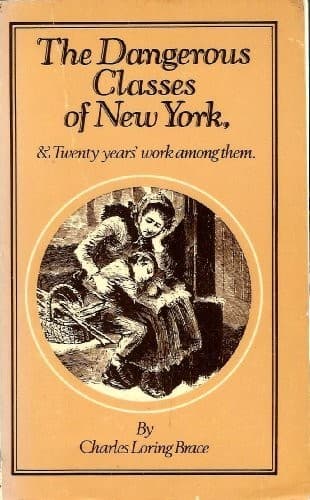
The Dangerous Classes of New York, and Twenty Years' Work Among ThemBrace, Charles Loring
History
The Dangerous Classes of New York, and Twenty Years' Work Among Them
Brace, Charles Loring
Child welfare -- New York (State) -- New York; New York (N.Y.) -- Social conditions; Poor -- New York (State) -- New York
Whenever the speaker could, for a moment only, open the hearts of the
little street-rovers to this voice, there was in the wild audience a
silence almost painful, and every one instinctively felt, with awe, a
mysterious Presence in the humble room, which blessed both those who
spake and those who heard.
Whatever was bold, or practical, or heroic in sentiment, and especially
the dramatic in oratory, was most intently listened to by these children
of misfortune.
The Boys' Meetings, however, were not, and could not, in the nature of
things, be a permanent success. They were the pioneer-work for more
profound labors for this class. They cleared the way, and showed the
character of the materials. Those engaged in them learned the fearful
nature of the evils they were struggling with, and how little any moral
influence on one day can do to combat them. These wild gatherings, like
meetings for street-preaching, do not seem suited to the habits of our
population; they are too much an occasion for frolic. They have given
way to, and been merged in, much more disciplined assemblages for
precisely the same class, which again are only one step in a long series
of moral efforts in their behalf, that are in operation each day of
every week and month, and extend through years.
The first of these meetings was opened in 1848, under the charge of Mr.
A. D. F. Randolph by the members of a Presbyterian church, in a hall on
the corner of Christopher and Hudson Streets. This was followed by
another in a subsequent year in Wooster Street, commenced by the
indefatigable exertions of the wife of Rev. Dr. G. B. Cheever, and
sustained especially by Mr. B. J. Howland and W. C. Russell.
The writer took more or less part in those, but was especially engaged
in founding one in Sixth Street, near Second Avenue; another in 118
Avenue D, from which arose the "Wilson School" and the Avenue D Mission;
one in King Street, near Hudson, from which came the Cottage-Place
Mission; and another in Greenwich Street, near Vandam Street.
CHAPTER VIII.
A NEW ORGANIZATION.
Public-domain text, read in full here on John Shaqi.
Reviews
Reviews
No reviews yet
Be the first to share your thoughts on this work.
Elsewhere in the archive
Join the Discussion
Join the discussion
Sign in to leave a comment or review.
Sign InorCreate an account