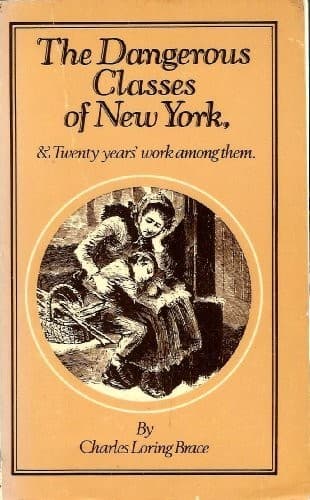
The Dangerous Classes of New York, and Twenty Years' Work Among ThemBrace, Charles Loring
History
The Dangerous Classes of New York, and Twenty Years' Work Among Them
Brace, Charles Loring
Child welfare -- New York (State) -- New York; New York (N.Y.) -- Social conditions; Poor -- New York (State) -- New York
In investigating closely the different parts of the city, with reference
to future movements for their benefit, I soon came to know certain
centres of crime and misery, until every lane and alley, with its filth
and wretchedness and vice, became familiar as the lanes of a country
homestead to its owner. There was the infamous German "Rag-pickers'
Den," in Pitt and Willett Streets--double rows of houses, flaunting with
dirty banners, and the yards heaped up with bones and refuse, where
cholera raged unchecked in its previous invasion. Here the wild life of
the children soon made them outcasts and thieves.
Then came the murderous blocks in Cherry and Water Streets, where so
many dark crimes were continually committed, and where the little girls
who flitted about with baskets and wrapped in old shawls became familiar
with vice before they were out of childhood.
There were the thieves' Lodging-houses' in the lower wards, where the
street-boys were trained by older pickpockets and burglars for their
nefarious callings; the low immigrant boarding-houses and vile cellars
of the First Ward, educating a youthful population for courses of guilt;
the notorious rogues' den in Laurens Street--"Rotten Row"--where, it was
said, no drove of animals could pass by and keep its numbers intact;
and, farther above, the community of young garroters and burglars around
Hamersley Street and Cottage Place. And, still more north, the dreadful
population of youthful ruffians and degraded men and women in "Poverty
Lane," near Sixteenth and Seventeenth streets and Ninth Avenue, which
subsequently ripened into the infamous "Nineteenth-street Gang."
On the east side, again, was "Dutch Hill," near Forty-second Street, the
squatters' village, whence issued so many of the little peddlers of the
city, and the Eleventh Ward and "Corlear's Hook," where the
"copper-pickers," and young wood-stealers, and the thieves who beset the
ship-yards congregated; while below, in the Sixth Ward, was the Italian
quarter, where houses could be seen crowded with children, monkeys,
dogs, and all the appurtenances of the corps of organ-grinders, harpers,
and the little Italian street-sweepers, who then, ignorant and
untrained, wandered through our down-town streets and alleys.
Near each one of these "fever nests," and centres of ignorance, crime,
and poverty, it was our hope and aim eventually to place some agency
which should be a moral and physical disinfectant--a seed of reform and
improvement amid the wilderness of vice and degradation.
It seemed a too enthusiastic hope to be realized; and, at times, the
waves of misery and guilt through these dark places appeared too
overwhelming and irresistible for any one effort or association of
efforts to be able to stem or oppose them.
How the somewhat ardent hope was realized, and the plan carried out,
will appear hereafter.
The first special effort that we put forth was the providing of work for
these children, by opening
Public-domain text, read in full here on John Shaqi.
Reviews
Reviews
No reviews yet
Be the first to share your thoughts on this work.
Elsewhere in the archive
Join the Discussion
Join the discussion
Sign in to leave a comment or review.
Sign InorCreate an account